REVIEW · BOSTON
Boston’s Freedom Trail: A Self-Guided Audio Tour
Book on Viator →Operated by VoiceMap Audio Tours · Bookable on Viator
Boston’s walk comes with a talking guide. This self-guided Freedom Trail route uses the VoiceMap app with offline audio, maps, and geodata, so you can keep moving without hunting for signal. You start at the Massachusetts State House and get a veteran guide’s voice as you link the landmarks into one easy-to-follow storyline.
Two things I really like: you can set your own pace (pause, linger, and come back when you’re ready), and you’re not limited to that day because there’s a virtual tour option you can revisit later at home. One thing to consider is that the app relies on you sticking to the planned route; if you wander off or try reversing direction, it can throw the directions off.
In This Review
- Key highlights at a glance
- Starting at the Massachusetts State House: where the tour clicks into place
- VoiceMap offline audio: why it’s useful on the Freedom Trail
- Granary Burial Ground: the forefathers stop that sets the tone
- Paul Revere’s grave area: 13 successful careers in one walk
- John Hancock’s grave and the Madeira wine trouble
- Omni Parker House: famous former guests and the strange overlap
- King’s Chapel built on top of a cemetery
- Old City Hall: the statue front and center
- Old South Meeting House and museum context
- Old State House and how to read the building
- Faneuil Hall and the Puritans connection
- Old North Church and Paul Revere’s rides
- Paul Revere Statue: learning what the horse is about
- Finishing at the Paul Revere House: the last standing structure feeling
- Price, timing, and how to judge value
- Practical tips to avoid the main app headaches
- Who should book this Freedom Trail self-guided audio tour?
- Should you book this Freedom Trail self-guided audio tour?
- FAQ
- How long is the Boston Freedom Trail self-guided audio tour?
- What does it cost?
- Where does the tour start and end?
- Is the tour self-paced?
- Do I need cellular service during the walk?
- What language is the audio tour in?
- What’s included in the price?
- Do I need tickets or museum entry fees?
- What do I need to bring?
- Is this tour private?
- Can I get a refund if I cancel?
Key highlights at a glance

- Offline access with VoiceMap: audio plus maps and geodata available without cellular service
- Turn-by-turn help: you get directions as you walk, not just background narration
- Lots of story stops: Granary Burial Ground, Paul Revere’s grave area, John Hancock, and more
- Lifetime access: replay the experience later, plus a virtual tour option
- Easy to fit into a busy day: plan on about 1 hour 15 minutes to 1 hour 30 minutes
Starting at the Massachusetts State House: where the tour clicks into place

Your walk begins in front of the Massachusetts State House at 24 Beacon St. It’s a smart start because it gives you a clear “top of the hill” orientation before the trail starts turning into names, dates, and smaller stories.
Right away, the audio explains how the VoiceMap app works. That matters more than it sounds. A self-guided tour can still feel smooth when the app clearly tells you when to look up, when to move, and how the route is structured. Here, you also get the big themes of the walk while you’re still fresh at the starting point—so the later stops feel connected instead of random.
Plan to give yourself a little patience at the very beginning. If the app doesn’t start instantly, you’ll waste time wandering around wondering what should happen next. The best move is to confirm your route is ready before you step into the flow of the trail.
You can also read our reviews of more guided tours in Boston



VoiceMap offline audio: why it’s useful on the Freedom Trail

Boston’s core is walkable, but phone signal can be inconsistent depending on where you are. What I like about this tour is that it’s designed for exactly that reality: offline access to audio, maps, and geodata. You’re not stuck waiting for loading screens or forced to keep your phone on mobile data.
That offline setup also makes the whole walk calmer. You can focus on the street scene and the buildings instead of watching a spinning icon. It’s also helpful for battery life, since you’re not constantly trying to refresh content.
Two practical notes:
- You’ll still need your own smartphone and headphones. Those aren’t included, so have a pair that you can tolerate for 60–90 minutes.
- If the app has technical issues, you’ll want to use the support route offered by VoiceMap (they list an email address, [email protected], for troubleshooting and refunds when appropriate).
Granary Burial Ground: the forefathers stop that sets the tone
After you’re oriented, the walk guides you through Granary Burial Ground—a stop centered on the graves of some of America’s forefathers. This is the kind of landmark where a guided voice helps, because the names on stone can feel flat until someone explains why they matter and how the people connect to Boston’s later narrative.
What makes this stop work on a self-guided format is that you can control how long you stand there. If you want quick context, you can move on. If you want to read and re-listen, you can.
Also, this is where the tour’s character shows. The audio is described as entertaining and story-driven, with humor included. That’s a big deal on sites like this, where you could otherwise end up with a tone that feels overly formal.
Paul Revere’s grave area: 13 successful careers in one walk

The route then passes by the Paul Revere Grave. While walking, you’ll hear about his 13 successful careers. That detail is the kind of thing that’s easy to miss if you’re just looking at a grave marker and moving on. Here, you’re guided to slow down just enough for the story to land.
A small warning from the way the directions work: the tour follows a set walking path. If you step away from that path to explore extra corners, you may lose your place in the directions. If that happens, use the app’s Resume option to pick up where you left off (the app can show the three closest locations so you can restart from the right spot).
John Hancock’s grave and the Madeira wine trouble

Next you pass by John Hancock’s Grave and hear about the trouble caused by his love of Madeira wine. That’s a great example of the tour doing something useful: it isn’t just listing names. It turns them into people with habits, missteps, and stories that you can remember.
This stop also gives you a chance to absorb the surrounding area. You don’t need to enter anything—this is all part of the walk—so you keep your schedule intact.
If you’re a reader who enjoys little side stories, this is one of those moments where you’ll likely find yourself thinking, Wait, that’s the kind of detail I never remember unless someone tells it.
You can also read our reviews of more tours and experiences in Boston






Omni Parker House: famous former guests and the strange overlap

The tour then passes by the Omni Parker House. While you walk, you’ll hear stories about famous former guests including Charles Dickens and John Wilkes Booth.
This is a neat stop because it connects different eras and different kinds of fame. It’s not just a “famous building” moment—it’s a “this place kept showing up in history” moment. And because it’s self-guided, you can spend a minute looking around the area before continuing without feeling like you’re interrupting a group.
King’s Chapel built on top of a cemetery

Next comes King’s Chapel. The audio explains why it was built on top of a cemetery. That kind of detail sticks, mainly because it’s not the first thing you’d guess when you see the building.
Again, this is a case where audio helps most. You can physically see the chapel, but you can’t “see” why that location works the way it does. The guided narration makes the stop feel like a real clue in a bigger puzzle.
Old City Hall: the statue front and center
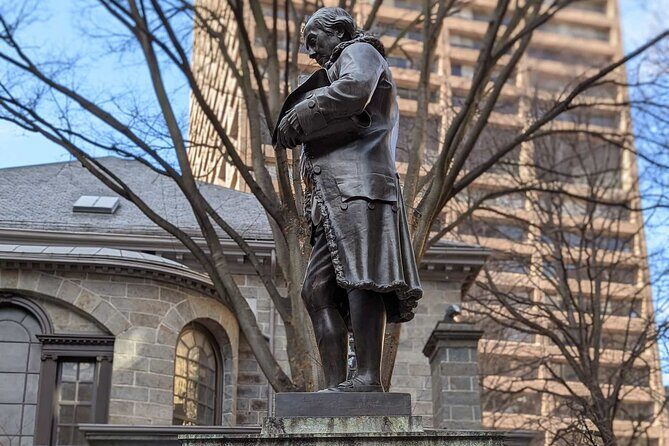
The walk passes by Old City Hall, and you’ll hear about the statue in front of the building. If statues are your thing, you’ll appreciate that the audio points you to look at a specific feature rather than asking you to guess what to pay attention to.
Even if you’re not a statue person, this works because it keeps your eyes moving. A self-guided tour can sometimes let your attention drift. Here, the audio nudges you to focus on one tangible thing at a time.
Old South Meeting House and museum context
Then you pass by the Old South Meeting House, with an explanation of the museum connection while you walk. This keeps the tour aligned with real places you’ll recognize even if you don’t stop inside.
One advantage: the tour doesn’t pressure you into extra tickets. No entrance fees are listed as included, so you can keep the walk “light” while still understanding what you’re seeing.
Old State House and how to read the building
The route continues to the Old State House, where you hear about the history of the building. It’s another stop designed around explanation rather than action. You’ll get the narrative while you’re in transit, which makes the walk feel more like a guided conversation than a checklist.
If you like structure, this is a comforting segment. You always know the audio is about the place you’re passing, not something floating in space.
Faneuil Hall and the Puritans connection
Next is Faneuil Hall, with an explanation of how the Puritans connect to the hall. This is where the trail starts feeling like it’s weaving ideas together, not just highlighting famous names.
What I like here is that it gives you a conceptual thread. Even without adding museum stops, you end up with a clearer sense of how people and beliefs shaped public life.
Old North Church and Paul Revere’s rides
Then you reach the Old North Church, where you’ll hear about some of Paul Revere’s many rides while you walk. Even if the exact details aren’t your focus, the “many rides” framing gives you a better sense of his role without making the whole story feel like a single moment.
This stop is also a good place to slow down. The audio helps you look past the obvious view and toward the storyline the trail is building.
Paul Revere Statue: learning what the horse is about
You then pass by the Paul Revere Statue and hear what you need to know about the horse Paul rode. That’s one of those small “pay attention here” prompts that makes the statue more than a background object.
This is also a moment where you can test your setup: if your audio is still playing smoothly and your app is still tracking your location, you’re in good shape. If you’ve been getting glitches, this is where you’ll notice right away and can correct by using the app’s Resume function if needed.
Finishing at the Paul Revere House: the last standing structure feeling
The tour ends in front of Boston’s oldest standing structure, the Paul Revere House, at 19 N Square.
Ending here feels satisfying because it gives you a physical anchor for the person whose stories have been popping up all along the route. You finish with a place you can point to, not just a memory of audio.
Once you reach the end, you can also take advantage of the tour’s longer tail: lifetime access and a virtual tour option for revisiting key moments at home. It’s a nice touch if you like refreshing your memory on the ride back or after you’ve had a chance to look up photos and maps.
Price, timing, and how to judge value
The price is $11.99 per person. For a Freedom Trail walk, that sounds reasonable because you’re paying for three things that are hard to DIY:
- Expert narration (a veteran guide voice with an entertaining tone)
- Offline map and direction support
- Lifetime access, including a virtual replay
The timing is also realistic: plan about 1 hour 15 minutes to 1 hour 30 minutes. That’s long enough to cover major stops without eating an entire day, and short enough to combine with other Boston plans.
A key value point: no museum tickets are included. That keeps costs predictable. You can decide on the fly whether you want to add entrances later, but the core experience stays intact as a walk.
Practical tips to avoid the main app headaches
The app is usually the star of this tour, but it can also be the thing that frustrates you if you’re not careful. Here are the issues to plan for:
- Stay on the route. The tour uses turn-by-turn directions along a set path. If you wander off to explore unrelated streets, it may be harder for the app to “catch back up.”
- Start in the correct direction. The route matters. If you start at the other end and try to reverse it, turn instructions can become confusing.
- Use Resume if you paused. If you stop to break, or you need to restart after a detour, the app’s Resume option can help you get back on track by showing nearby starting points.
- Download and test early. Since offline audio depends on the phone having what it needs, give yourself time at the start to ensure the app runs smoothly before you commit to walking.
If something goes seriously wrong, VoiceMap lists support through email and telephone. Their email is [email protected], and they note they can troubleshoot and process a refund when details are provided.
Who should book this Freedom Trail self-guided audio tour?
This is a great fit if you want:
- Flexibility over a rigid guided group schedule
- A voice that mixes facts with humor
- A walk you can pace yourself—especially if you like stopping to look closely at plaques, graves, and monuments
It’s also a good choice if you’re traveling without a plan to spend money on multiple attractions mid-walk. You’ll learn as you go, and you’re not locked into any additional entrances.
If you’re the type who needs a live person constantly correcting you, or you get annoyed when apps misbehave, you might feel more stress. In that case, consider whether you’d rather do a guided walking tour with fewer tech dependencies.
Should you book this Freedom Trail self-guided audio tour?
I’d book it if you want a low-pressure Freedom Trail day with strong storytelling and offline audio. The $11.99 price is easy to justify when you think about the practical side: you’re buying a guide voice plus directions plus maps you can use even without cellular service.
I’d hesitate if you’re worried about app downloads or you know you’ll likely wander far from the main route. The biggest “gotcha” isn’t the history—it’s keeping your phone and your feet aligned with the planned path.
If you’re okay following the route and using Resume when needed, this is one of the smarter ways to experience Boston’s Freedom Trail at your own speed.
FAQ
How long is the Boston Freedom Trail self-guided audio tour?
It takes about 1 hour 15 minutes to 1 hour 30 minutes based on the walking route and timing.
What does it cost?
The price is $11.99 per person.
Where does the tour start and end?
It starts in front of the Massachusetts State House, 24 Beacon St, Boston, MA 02133, and ends in front of the Paul Revere House, 19 N Square, Boston, MA 02113.
Is the tour self-paced?
Yes. It’s a self-guided, self-paced walking tour following the Freedom Trail.
Do I need cellular service during the walk?
No. It includes offline access to audio, maps, and geodata, so you don’t need cellular service.
What language is the audio tour in?
The tour is offered in English.
What’s included in the price?
You get lifetime access to the tour in English, offline audio and maps support, and the VoiceMap app for Android and iOS.
Do I need tickets or museum entry fees?
No tickets are included for museums or other attractions along the way, so entrance fees are not part of this experience.
What do I need to bring?
You’ll need your own smartphone and headphones. Those items are not included.
Is this tour private?
It’s listed as a private tour/activity, meaning only your group participates.
Can I get a refund if I cancel?
No. The experience is non-refundable and cannot be changed for any reason.