REVIEW · BOSTON
Boston: Freedom Trail History Small Group Walking Tour
Book on Viator →Operated by Hub Town Tours · Bookable on Viator
Boston history walks itself into your day. This Freedom Trail tour strings together the years 1760 to 1775 and takes you to 16 official landmarks from Boston Common to Copp’s Hill. Along the way, your historian guide explains why key places mattered when tensions were rising toward independence.
I love how the tour is focused, not random. You get a tight 1760 to 1775 storyline, and the small group format keeps it interactive as you ask questions on the sidewalk.
One thing to plan for: you spend most of your time at outside stops, and museum entry isn’t included, so you may need extra visits if you want to go in.
In This Review
- Key highlights worth your time
- The Freedom Trail route that makes the Revolution feel logical
- Where the tour starts and where you end on purpose
- Boston Common: the outdoor “center of gravity” for 1760s tension
- Granary Burying Ground: graves as a Revolution timeline
- Franklin, schools, politics, and meeting houses: the power behind the slogans
- Boston Massacre Site: where the story gets sharp
- Faneuil Hall Marketplace: the public meeting machine
- North Square Park and the North End: walking into the Paul Revere story
- Copp’s Hill Terrace finale: wide views, big names
- What you’ll notice about the guides (and why it matters)
- Pace, fitness, and who this tour fits best
- Price and value: is $35.10 worth it?
- Tips to get the most out of your Freedom Trail walk
- Should you book this Freedom Trail history tour?
- FAQ
- How long is the Freedom Trail history walking tour?
- Where does the tour start and end?
- What landmarks does the tour include?
- Is the tour wheelchair and stroller accessible?
- Is admission to museums included?
- What language is the tour offered in, and do I get a ticket?
- How big is the group?
- What is the cancellation policy?
Key highlights worth your time
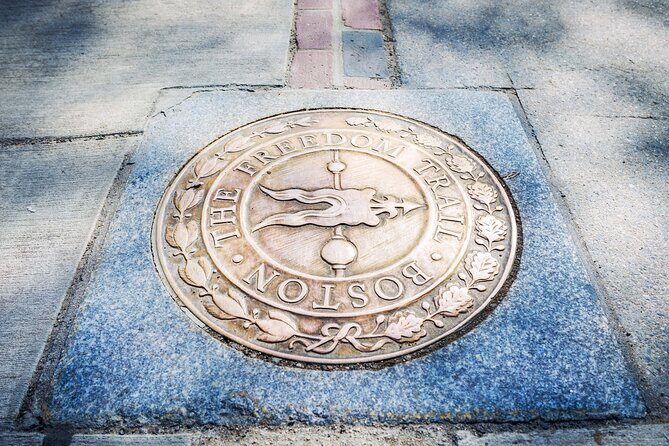
- All 16 official Freedom Trail landmarks in one efficient route, ending with a great harbor-side finale
- Revolution years 1760 to 1775 told in order, so events click together faster than a typical stop-by-stop tour
- Historian-style Q&A at real street-level locations, not just recited facts from a plaque
- Practical pacing for a 2.5-hour walk through Downtown Boston and the North End (Charlestown is not included)
- Winter-friendly approach when weather is rough, with opportunities for warmer indoor pauses
The Freedom Trail route that makes the Revolution feel logical
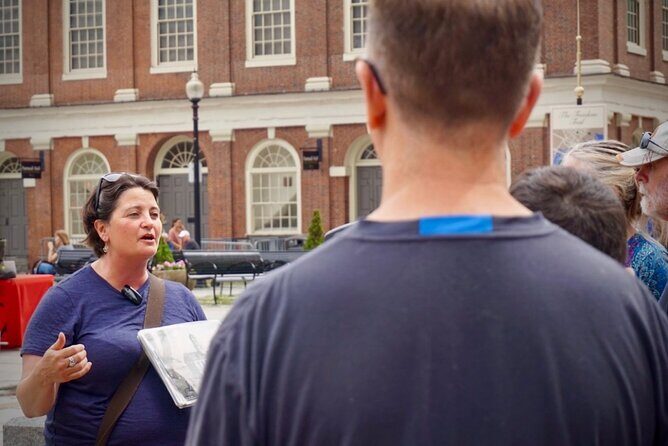
Boston can overwhelm you fast. The city has “Revolution” in a lot of places, but it’s easy to leave with a pile of dates and no cause-and-effect. This tour helps by organizing the story around a specific window: the lead-up to rebellion between 1760 and 1775.
That focus matters. When the guide connects politics, street events, publishing, and public meetings to what you’re standing in front of, the Revolution stops feeling like a textbook chapter. Instead, it becomes a chain of arguments and actions happening right on these blocks.
You also get the whole arc in one sweep. The walk moves from the broad civic center (Boston Common) into burial grounds tied to early communities, then toward the power hubs of town meetings and protest—before finishing with iconic images of Paul Revere and the night signals.
You can also read our reviews of more walking tours in Boston


Where the tour starts and where you end on purpose
You meet near Boston Common at the Boston Foundation Monument (49 Beacon St), on the northern boundary of the park, by the 300th Anniversary Monument area. It’s an easy starting point because it’s central and simple to find, and the tour kicks off once your small group is assembled and ready.
The tour ends at Copp’s Hill Terrace (520 Commercial St), with views across the Charles River toward U.S.S. Constitution and Bunker Hill Monument. That finish is more than scenery. It gives you a moment to zoom out and connect the names you’ve just heard to the bigger geography of the Revolution.
If you like to keep momentum after tours, the ending location is convenient too. Copp’s Hill is steps from Hanover Street, where you’ll find lots of easy meal options—pizza, pastries, and classic Italian spots.
Boston Common: the outdoor “center of gravity” for 1760s tension
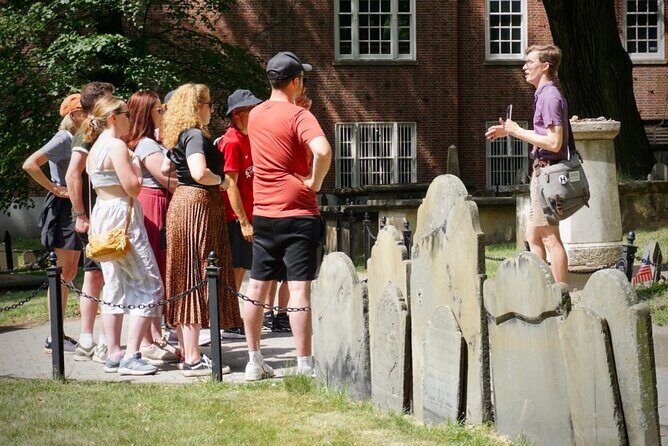
Your first real landmark moments land on Boston Common. This is the oldest public land in the Americas, dating to 1634, and the guide frames it as communal space where the city’s life gathered.
That context is useful because Boston Common isn’t just a park you pass through. It’s a place where public decisions, public pressure, and public visibility all overlap. Even if you’ve seen it from photos, the stories make it feel like a stage.
This portion also works as an orientation walk. You’re learning how Boston’s layout influenced how news traveled and how crowds formed—before you move into more specific Revolution-era sites.
Granary Burying Ground: graves as a Revolution timeline
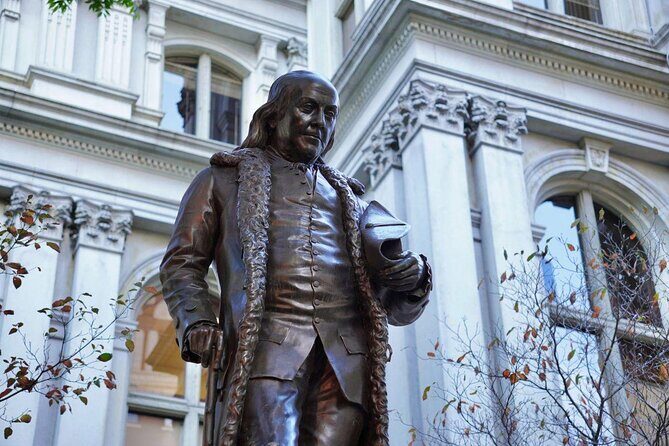
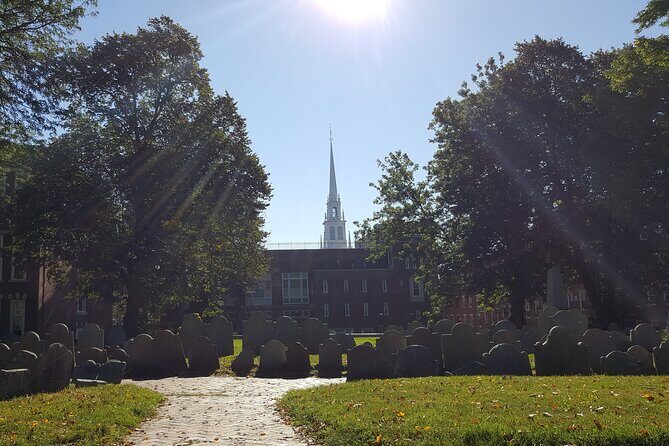
Next comes the Granary Burying Ground, Boston’s third-oldest burying ground and a final resting place for Revolutionary-era Boston. This is where the tour adds weight. It’s harder to treat history as distant once you’re standing near burial plots connected to the same communities shaping rebellion.
The guide also points out how these older burial grounds function like early maps of identity—who mattered in the city and what kinds of people shaped public life. The stop is short, but it sets a tone: Revolution isn’t only speeches and riots. It’s also families, neighbors, and long-term consequences.
If you tend to rush past cemeteries, this one is worth slowing down for. The guide’s storytelling turns the stones into context rather than just scenery.
Franklin, schools, politics, and meeting houses: the power behind the slogans
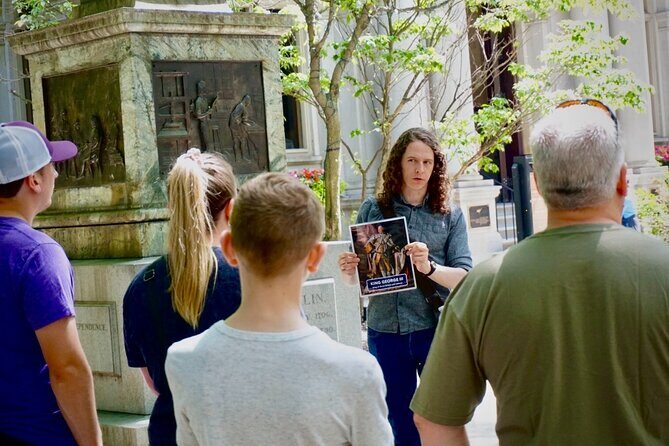
A standout chunk of the walk centers on the area around the Statue of Benjamin Franklin. It’s tied to the Boston Latin School—often cited as the oldest public school in the Americas (founded 1635). The point is simple: education and civic ideas helped fuel political arguments.
From there, the tour threads through multiple layers of Boston’s decision-making. You’ll hear about the center of Boston politics for more than a century and see references tied to publishing (like Ticknor & Fields, 1718). These details matter because revolutionary anger didn’t only come from war news. It came from how people argued—through print, debate, and organized persuasion.
You’ll also pause near religious and civic sites that shaped community life. For example, there are notes on an origin site tied to the Boston Tea Party (1773) connected to a Congregationalist meeting house (1729). The tour makes the connection that “politics” in this era often ran through church-linked meeting culture too.
Then there’s a stop that connects you to Boston’s long governmental spine. The walk includes the Massachusetts state capitol / Hub of the Solar System reference (1798) and an older colonial capitol reference (1713) that ties back to the Massachusetts Bay Colony. This helps you understand why the same neighborhoods kept pulling political power into the street.
One caution here: there’s a lot packed into a limited amount of time. If you’re the type who loves architectural trivia, you’ll want to jot down a couple places you want to return to later, because the tour moves at a history-intense pace.
You can also read our reviews of more historical tours in Boston






Boston Massacre Site: where the story gets sharp
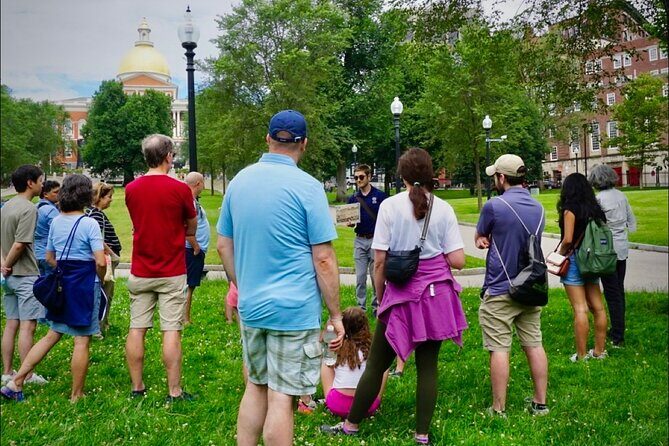
At the Boston Massacre Site (1770), the tour focuses on a moment when British soldiers killed five Bostonians. This is the kind of event that changes everything, because it becomes a symbol.
The guide also links the site to the Sons of Liberty and the political energy surrounding it. The value of this stop is how it explains why the massacre mattered beyond the immediate violence—how it was used to argue that British authority was illegitimate and dangerous.
You don’t need to be a “battlefield person” to appreciate this. The emotional power of the moment hits differently when it’s tied to the nearby meeting spaces and the print-and-public-outcry world you just learned about.
Faneuil Hall Marketplace: the public meeting machine
The walk moves to Faneuil Hall Marketplace, described as the place associated with Boston’s town meetings and often called The Cradle of Liberty. The building’s 1742 date isn’t just trivia here. It’s a reminder that this city has long treated public talk as a form of power.
The tour also calls out that an older historic restaurant sits here (the oldest restaurant in the United States, dated to 1826, in a historic building from 1704). That’s a fun aside, but it also reinforces something important: these sites didn’t stop being part of city life after the Revolution. They kept working as community centers.
Faneuil Hall is where you start to feel the rhythm of how revolution gathered momentum—through meetings, through speech, and through turning public frustration into organized action.
North Square Park and the North End: walking into the Paul Revere story
In the North End, you hit North Square Park (historic public square in the heart of the North End, dating to 1634). This stop sets you down in the kinds of tight, lived-in streets that helped explain why messages could spread quickly and why crowds could form fast.
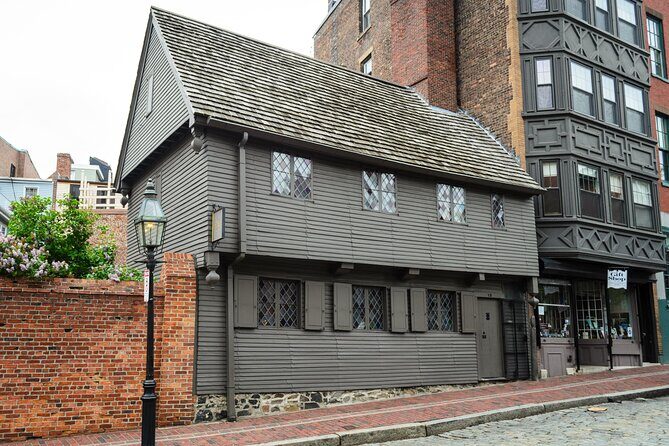
The tour then connects you to Paul Revere, including the home reference (1680) described as the oldest structure in Downtown Boston. This is one of those times where the guide’s storytelling style makes history feel personal, not just famous.
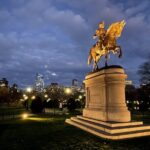
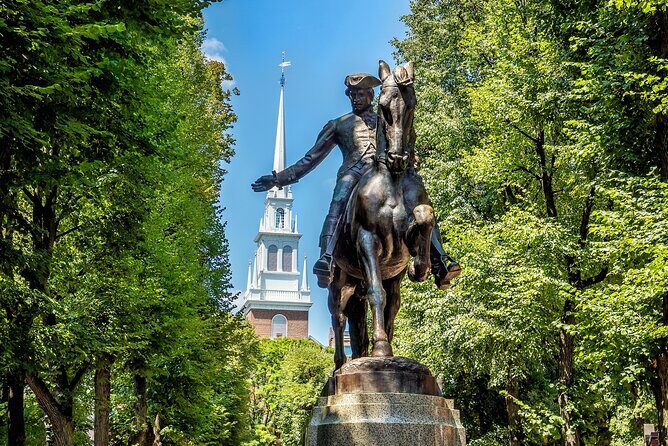
You end up at the Paul Revere Statue, in a pedestrian-only space honoring the Midnight Ride (1775). Even if you’ve seen Revere images before, the stop hits better when you’ve already covered the political and protest context that made a ride like that meaningful.
Then the tour points you toward the nearby church signal-lantern connection. It notes that Boston’s oldest church held signal lanterns during the Midnight Ride (1723). That detail is crucial because it explains how communication worked in the moment—fast, local, and built on trusted systems.
Copp’s Hill Terrace finale: wide views, big names
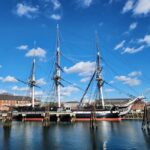
Your tour concludes at Copps Hill Terrace overlooking the Charles River. The guide frames the view by pointing you toward two major Freedom Trail landmarks across the water: the U.S.S. Constitution (1797) and Bunker Hill Monument (1775 battle).
This is a smart way to end because it turns your route into a map. You can look across and connect the “story in your head” to the geography of what happened next.
If you’re the type who likes a final emotional beat, this finale can do that too. Several guides have a knack for closing with the kind of spoken storytelling that makes the Revolution feel immediate rather than archived.
What you’ll notice about the guides (and why it matters)
The quality of this tour is tightly linked to the guide. The most praised guides share a few consistent skills: clear chronology, confident answering of questions, and an ability to connect small details to the big arc.
For example, Jon is noted for walking through the history chronologically, with a closing that can land hard emotionally. Alejandro is described as very considerate on cold days, using indoor pauses and telling the stories in a way that keeps the group engaged. Maura is praised for vivid storytelling that paints revolutionary Boston instead of listing facts. Miles is highlighted for actor-style storytelling and lots of specific detail. Amelia gets called out for strong area knowledge and a real passion for the neighborhood.
You don’t need to memorize what each guide says. You’ll get more out of the tour by asking one or two good questions as you walk—about how people communicated, why certain meetings mattered, or how the British presence shaped public life.
Pace, fitness, and who this tour fits best
This is a 2.5-hour walking tour with a moderate physical fitness level recommended. It’s also not recommended if you have difficulty standing for extended periods.
The good news: the walk is designed for mainstream access needs. It’s listed as wheelchair and stroller accessible, and service animals are allowed. The tour also runs with a maximum of 16 travelers, which helps keep the group manageable and the Q&A realistic.
The route covers Downtown Boston and the North End. Charlestown isn’t included, so if you’re hoping to hit all of the most famous Boston sites in one day, you’ll likely want a separate plan for that area.
Who it suits best:
- First-time Boston visitors who want the Freedom Trail story without researching every plaque
- History fans who like context and cause-and-effect
- Families who want a walk they can still steer with questions
Price and value: is $35.10 worth it?
At $35.10 per person, the value here is the combination of route efficiency and guided storytelling. You’re paying for a historian-led walk that hits all 16 official landmarks rather than piecing it together on your own.
If you try DIY, you’d still need to read a lot of material to understand the timeline. This tour compresses that work into a guided format, and it’s small enough that questions don’t disappear into a crowd.
The one tradeoff is admissions. Museum entry isn’t included, and the tour time doesn’t seem built for frequent inside stops. If you love going inside buildings, you’ll likely treat this as your orientation plus storytelling pass, then use your findings to choose which museums to visit next.
Tips to get the most out of your Freedom Trail walk
- Wear shoes you trust. This is a true walking tour, not a trolley hop.
- Bring layers. The tour is weather-dependent, and conditions can get windy and cold even when the route feels short on a map.
- Use your question time strategically. Ask how one stop connects to the next. That’s where you’ll gain the most clarity.
- Plan at least one follow-up visit if you care about interiors. The guide can show you what’s outside and explain the why, but you’ll need extra time for inside experiences.
Also, if you’re doing this winter, pay attention to warmth breaks. The tour uses indoor pauses when available, and some guides build a halfway warm-up into the flow—helpful if you start the walk under freezing conditions.
Should you book this Freedom Trail history tour?
Book it if you want a clear Revolutionary-era storyline delivered at walking speed, with all 16 official landmarks handled in one outing. The price is reasonable for what you get: a structured 1760–1775 narrative, a small group size, and a historian who answers questions instead of rushing you through.
Skip it or pair it with other plans if you strongly prefer museum interiors, because this is mostly about street-level stops and outside viewing. Also note that Charlestown isn’t included, so you’ll need to decide what you want to see on the other side of the river if that’s a priority.
FAQ
How long is the Freedom Trail history walking tour?
It runs about 2 hours 30 minutes.
Where does the tour start and end?
It starts at the Boston Foundation Monument on 49 Beacon St near Boston Common and ends at Copp’s Hill Terrace, 520 Commercial St.
What landmarks does the tour include?
The experience includes all 16 official Freedom Trail landmarks and covers Downtown Boston and the North End.
Is the tour wheelchair and stroller accessible?
Yes. The tour is listed as wheelchair and stroller accessible, and service animals are allowed.
Is admission to museums included?
No. Admission inside museums is not included.
What language is the tour offered in, and do I get a ticket?
The tour is offered in English, and you receive a mobile ticket.
How big is the group?
The group maximum is 16 travelers.
What is the cancellation policy?
You can cancel for a full refund if you cancel at least 24 hours in advance. If you cancel less than 24 hours before the start time, the amount paid is not refunded. The experience also requires good weather and may be rescheduled or refunded if poor weather cancels it.