REVIEW · BOSTON
Freedom Trail Guided Walking Tour (SMALL GROUP)
Book on Viator →Operated by PhotoWalks · Bookable on Viator
Boston history on foot, with photo tips.
This Freedom Trail guided walking tour gives you a fast, fun way to connect names like John Hancock and Paul Revere to real places, plus smart guidance for taking better smartphone photos along the route. I like that the stories focus on what really happened (and where the myths get messy), and I like the small-group feel that keeps the pace human. One thing to plan for: you won’t hit every Freedom Trail stop, and the tour has no restroom stops.
You start at Park Street Church and finish at Faneuil Hall Marketplace, walking some of Boston’s most recognizable Revolutionary-era sites in about 1 hour 30 minutes. The group is capped at 15, led by longtime local guide Saba Alhadi, and you’ll get a mobile ticket and English commentary to keep you on track. If you want a complete 2.5-mile, all-16-sites Freedom Trail day, this isn’t that tour—but it’s a strong way to get your bearings fast.
In This Review
- Key things to know before you go
- Why this Freedom Trail Walk Feels More Useful Than a Basic Tour
- Route Reality: Park Street Church Start to Faneuil Hall End
- Stop-by-Stop: What Each Freedom Trail Site Gives You
- Freedom Trail kickoff: the story behind the sites
- Boston Common: the old starting point you can feel
- Massachusetts State House (the golden dome stop)
- Park Street Church: abolitionist ties plus a view
- Granary Burial Ground: names you keep seeing
- King’s Chapel and the oldest burying ground angle
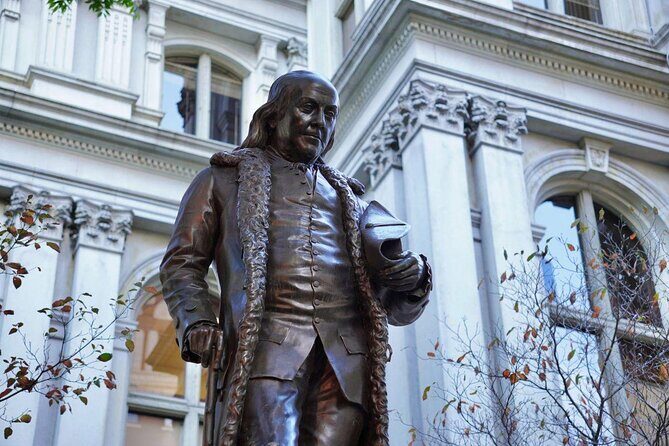
- Statue of Benjamin Franklin: the Boston Latin School marker
- Old Corner Bookstore: 1718 roots, 1828 bookstore life
- Old South Meeting House: protest energy before Tea Day
- Old State House: where major drama played out
- Boston Massacre site: the moment that turned up the heat
- Faneuil Hall Marketplace: the cradle-of-liberty feeling
- The Boston sign: a bright end to a serious walk
- Photo Tips on the Move: What You’ll Actually Get
- What You Learn: Myth-Busting Without Turning Into a Lecture
- What’s Not Included (and How to Pair It)
- Price and Value: Is $45 Fair for 90 Minutes?
- Group Size, Pace, and Practical Tips That Prevent Frustration
- Who Should Book This Freedom Trail Guided Walking Tour
- Should you book it?
- FAQ
- Is Paul Revere’s House included in this tour?
- How long is the Freedom Trail Guided Walking Tour?
- Where does the tour start and end?
- Is this tour good for families or kids?
- What language is the tour offered in?
- What is the group size limit?
- Are there restroom stops during the walk?
- Is admission included for all stops?
- Do I need a printed ticket?
Key things to know before you go
- Small-group format (max 15): easier to hear, ask questions, and move at a comfortable pace.
- Smartphone photo tips built in: framing and composition prompts, not a photography class.
- Myth-versus-fact storytelling: includes discussion of Paul Revere, the Boston Massacre, and the Tea Party.
- You’ll see the big name sites: Boston Common, Park Street Church, Granary Burying Ground, Faneuil Hall, and more.
- Important exclusions: Paul Revere’s House + Old North Church are not part of this walk.
- No restroom stops: plan accordingly, especially in hot months.
Why this Freedom Trail Walk Feels More Useful Than a Basic Tour
Boston’s Freedom Trail can sound like a homework assignment: dates, places, and famous names. This tour makes it feel practical. You get guided stops that tie specific people to specific corners of downtown, so the history doesn’t stay trapped in your head like a flashcard deck.
Two parts especially help you. First, the guide’s approach leans on the story behind the story—what happened on key nights and how famous poems or simplified versions can be wrong. Second, the photo guidance is aimed at real-world photos you can take on your phone while walking. You’re not dragged into a classroom lesson; you’re handed small cues that improve the photos you’ll actually want to keep.
The trade-off is time. The full Freedom Trail is 2.5 miles with 16 historic sites, and this 90-minute route covers 11 of them. That’s a big chunk, but it means you’ll need to decide whether you want depth across fewer stops—or a quick sweep.
You can also read our reviews of more walking tours in Boston

Route Reality: Park Street Church Start to Faneuil Hall End
The tour starts at Park Street Church (1 Park St, Boston) and ends at Faneuil Hall Marketplace. Your start time is 1:15 pm, and the meeting point is close to public transportation. Aim to arrive about 10 minutes early so you’re ready when the walk begins.
You’re moving on foot through the Downtown Boston core, and the pace is built for a one-and-a-half-hour window. That matters because you’re not just reading plaques—you’re getting guided explanation in the right spot, then quickly moving onward.
The route’s structure is also smart for first-time visitors. It begins with the trail’s well-known anchor areas (Boston Common and the early-government buildings) and works through major Revolutionary landmarks. By the time you reach Faneuil Hall and the final “Boston” photo spot, the themes click: protest, escalation, and the machinery of independence.
Stop-by-Stop: What Each Freedom Trail Site Gives You
Below is what you can expect at each major moment on the walk—what makes it worth your attention, and what to watch for while you’re there.
Freedom Trail kickoff: the story behind the sites
The first stop is the Freedom Trail overview itself, where the guide frames the whole walk around the events that led to the American Revolution in 1775. This is where you get the narrative thread: who mattered, what happened on key nights, and how the Boston Massacre and Boston Tea Party fit into the bigger timeline.
This is also where the tour does one of its best jobs: it talks about the famous version versus the real version. If you’ve heard the Paul Revere story as a simple midnight ride, you’ll come away with a more grounded sense of what was going on.
Boston Common: the old starting point you can feel
Next up is Boston Common, the official starting point of the trail. It’s the oldest public park in the United States, so even before the Revolutionary details, the setting already signals weight and age.
Practical tip: treat the open space as a chance to steady your phone and get a clean wide shot before the route tightens into narrower streets and tighter angles.
You can also read our reviews of more guided tours in Boston




Massachusetts State House (the golden dome stop)
Right after the Common, you’ll hit the major “golden dome” landmark: the Massachusetts State House, seat of the Massachusetts government. The guide uses this stop to connect the Revolution era to the idea of self-governance and political action.
This is a good moment for photos, but keep it realistic: downtown angles can be busy. Use the guide’s framing cues to get the dome cleanly without turning your image into a traffic-cam.
Park Street Church: abolitionist ties plus a view
At Park Street Church, you get the steeple and the abolitionist history. The way the church sits overlooking Boston Common makes it useful for photos and for understanding how the city’s institutions gained visibility.
Look for the chance to include both the church and the open Common area in a single composition. It helps your photos tell a story, not just show a landmark.
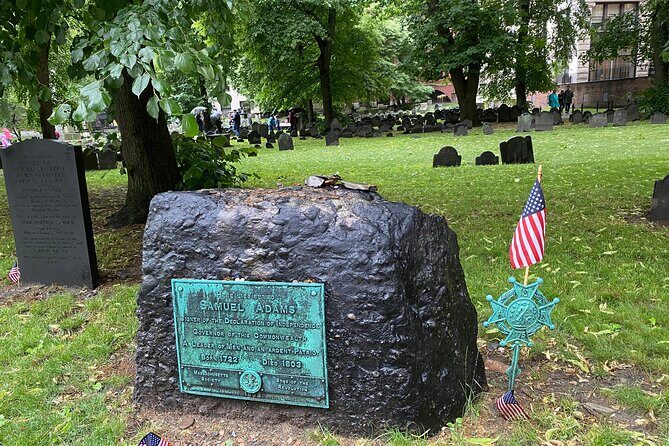
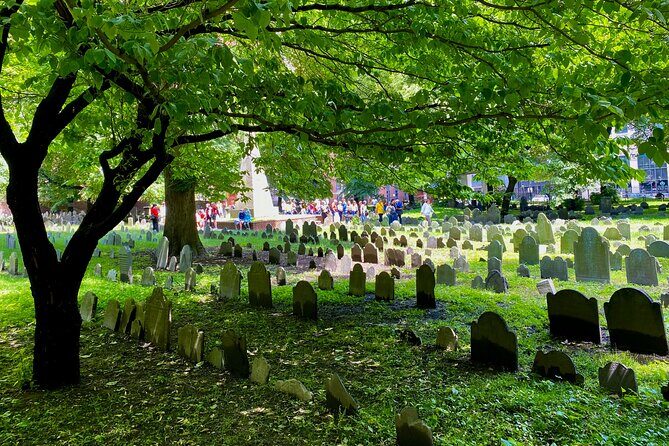
Granary Burial Ground: names you keep seeing
The tour then reaches Granary Burial Ground, an important cemetery tied directly to revolutionary figures. Places like this are where Boston stops feeling like a set of buildings and starts feeling like a living ledger of names.
Photo-wise: cemetery stones can be hard to shoot if the light is harsh. If your phone is fighting glare, adjust your angle slightly and shoot from where the stone texture stays readable.
King’s Chapel and the oldest burying ground angle
You’ll also visit King’s Chapel (noted for historic stone architecture and its colonial-era origins). Then the tour adds a quick stop at a nearby cemetery connection described as Boston’s oldest burying ground dating back to 1630.
These short segments matter because they add texture. Revolutionary history isn’t only speeches and protests; it’s also the long sweep of who lived here, worshipped here, and is remembered here.
Statue of Benjamin Franklin: the Boston Latin School marker
At the Benjamin Franklin statue, the emphasis is on what the statue marks: the original site of Boston Latin School, described as the first public school in America. This is a great break from the politics-only view and a reminder that revolutions need brains, not just banners.
If you like “secondary meaning” photos, this is the stop. You can shoot the statue and then angle your frame to hint at why the education story belongs on the Freedom Trail.
Old Corner Bookstore: 1718 roots, 1828 bookstore life
Next is Old Corner Bookstore, originally built as a residence and apothecary, then operating as a bookstore in 1828. This stop adds everyday culture to a trail that can otherwise feel like only government and conflict.
Practical photo note: storefronts and signage can turn into flat shots. Use the guide’s composition ideas—think about depth by including streetscape lines and not just the front facade.
Old South Meeting House: protest energy before Tea Day
Then you’ll reach Old South Meeting House, tied to colonists protesting British rule leading up to the Boston Tea Party in 1773. This stop is where the tour’s theme of escalation becomes concrete: talk turns to action.
Expect it to feel like a gathering place even if you’re standing outside. That’s the point. The guide helps you visualize how crowds and meetings shaped the next steps.
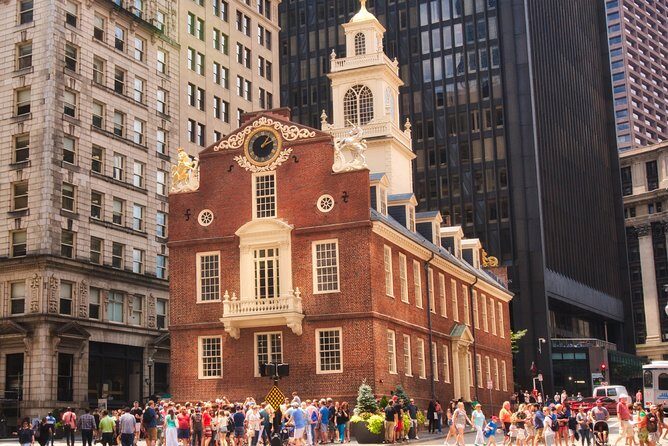
Old State House: where major drama played out
At the Old State House, you’ll hear about the site of the Boston Massacre and the reading of the Declaration of Independence to colonists in 1776. It’s a big, heavy stop, and it lands well because it sits in a broader political geography you’ve already been walking through.
If you’re taking photos: this is often a “choose one shot” moment. Don’t try to capture everything at once—pick an angle that keeps the story clear.
Boston Massacre site: the moment that turned up the heat
The walk then focuses on the Boston Massacre site, marking where British soldiers fired on colonists in 1770. The guide uses this to explain how those events pushed tensions forward toward revolution.
This is also a smart place to slow down. In your photos, keep your frame simple so your image doesn’t look like a crowd-control accident.
Faneuil Hall Marketplace: the cradle-of-liberty feeling
Finally, the tour heads to Faneuil Hall Marketplace, often called the Cradle of Liberty for its role as a meeting hall during the fight for independence.
This stop works because it’s both historic and alive. You get a sense of purpose tied to action: people gathered, debated, and moved the city.
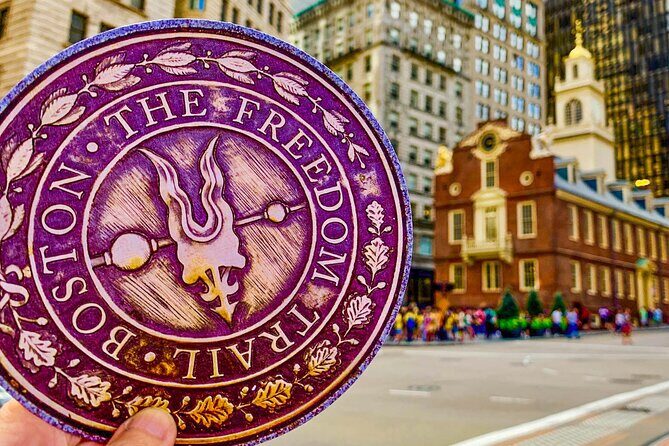
The Boston sign: a bright end to a serious walk
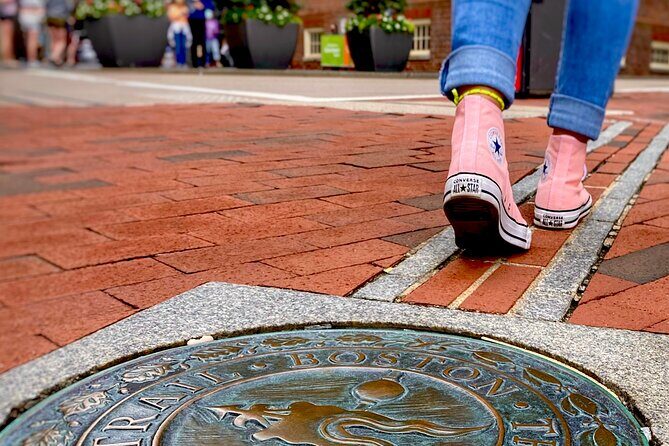
To wrap, you’ll stop at the Boston sign on City Hall Plaza, with Faneuil Hall as a background anchor. This is your easy win photo moment—a cheerful finish after all the heavy story beats.
If you want photos that look “clean and intentional,” this is exactly that kind of setup. Keep your horizon level and use Faneuil Hall in the background as context.
Photo Tips on the Move: What You’ll Actually Get
This is a history-focused walk with smart smartphone photo tips, not a dedicated photography class. That’s a good thing, because the tips are meant to support the sightseeing instead of stealing time from it.
From the way people describe the experience, the photo help tends to cover things like:
- how to frame historic buildings so they don’t look crooked or flat
- how to use contrast and color around older stone and darker street lines
- how to think about grouping elements in one shot so the result feels like a postcard, not a single landmark snapshot
- practical smartphone habits for shooting and organizing the photos afterward
One review noted the idea of applying older photography concepts to phone images—composition, grouping, framing—so you don’t need a fancy camera to improve your keepers. Another key theme: the guide keeps the photo moments moving so you stay part of the group rather than falling behind.
If you’re coming with a brand-new phone and zero photo patience, this tour still works. It’s not about learning everything. It’s about getting a few repeatable habits that make the next Boston photo day better too.
What You Learn: Myth-Busting Without Turning Into a Lecture
The best part of this tour’s teaching style is that it stays tethered to events and locations. The guide discusses major themes like:
- what happened on the eve of the Revolution involving Paul Revere
- why common versions of the Paul Revere story can get details wrong
- what caused the Boston Massacre to escalate tensions
- what led to the Boston Tea Party
- how the Declaration of Independence is tied to real dates and real people, including correction of misunderstandings about who signed it
You’ll also hear fun facts about figures you’ve already met in textbooks: John Hancock, Samuel Adams, and Paul Revere. The goal isn’t to throw names at you. It’s to help the names stick to the places you’re seeing.
One note on expectations: because the tour is 90 minutes, you won’t get courtroom-style detail for every event. Instead, you get the key story beats and the clarifications that matter most for understanding what you’re standing in front of.
What’s Not Included (and How to Pair It)
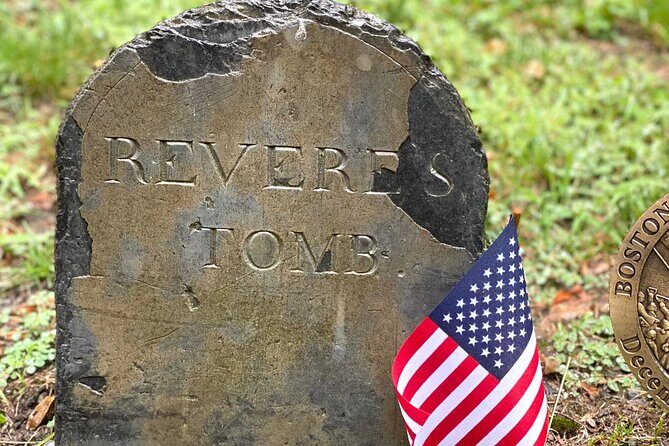
Two important exclusions shape your planning:
- Paul Revere’s House is not included here.
- Old North Church is not included here.
Instead, those are part of a separate North End-focused photo walking tour. If you’re the kind of traveler who wants the whole Freedom Trail story line in one visit, you can make your own “two-tour day” plan: do this Revolutionary core walk for context, then pair it with the North End route for the Revere/Old North landmarks.
Also, remember that this walk covers 11 of the Freedom Trail’s 16 historic sites. If you love breadth and can handle missing a few pieces, you’re set. If you want every stop, you’ll need a longer tour or a second walk.
Price and Value: Is $45 Fair for 90 Minutes?
At $45 per person for about 1 hour 30 minutes, you’re paying for guided storytelling plus the added value of on-the-spot photo instruction. You also get a mobile ticket, and the tour includes admission tickets at several stops (while some stops are noted as not including admission and are essentially exterior or short segments).
Is it a budget price? No. But for downtown Boston, guided walking tours that focus on the Revolutionary sites often cost more, and what you’re buying here is not just movement—it’s interpretation. People describe it as worth the money because the guide makes the landmarks easier to remember, and the photo tips help you take away something tangible from the day.
If you’re someone who will only tolerate museums and hates walking, skip it. If you can handle a moderate walking pace, it’s one of the better uses of a limited Boston afternoon.
Group Size, Pace, and Practical Tips That Prevent Frustration
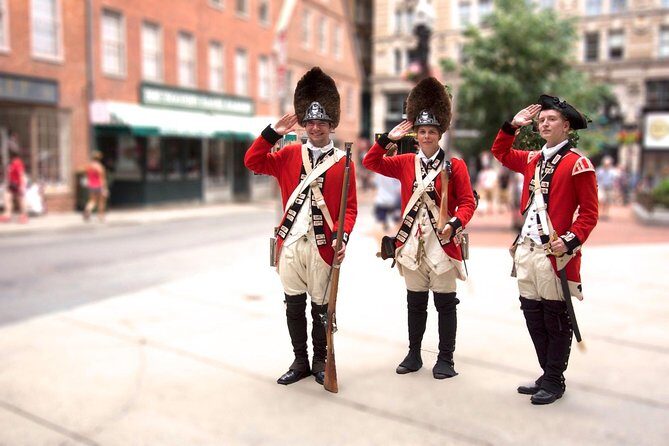
The group is capped at 15, which is a big deal on a Freedom Trail walk. Smaller groups usually mean the guide can keep eyes on the whole line and adjust pacing for questions.
Still, if you’re sensitive to crowding, know that Boston is busy and the streets can get loud. The tour starts at Park Street Church and moves through dense downtown, so you’ll want to keep your phone charged and your route expectations realistic.
Three practical points to keep you comfortable:
- No restroom stops. Plan to use facilities before the tour.
- Moderate physical fitness level. It’s a walking tour, so wear shoes you trust.
- Weather matters. This is described as requiring good weather, so have a backup mindset for heat, wind, or rain.
Finally, the tour requests that you reconfirm at least 48 hours prior by email or text. It’s a small step, but it prevents last-minute confusion.
Who Should Book This Freedom Trail Guided Walking Tour
This tour is a great match if you:
- want Revolution-era context fast without a full-day commitment
- like history that explains why the story changed or got simplified
- want photo guidance you can apply right away on your smartphone
- travel with a partner, family group, or solo and prefer a manageable group size
- enjoy being able to ask questions and get answers while you walk
It’s less ideal if you:
- need a restroom stop during the route
- want the entire 2.5-mile trail and all 16 sites in one go
- are only interested in the North End Revolutionary stops like Old North and Paul Revere’s House
Should you book it?
Yes—with one caveat. Book this if you want a smart, time-efficient Freedom Trail overview with photo tips that actually help and a guide who keeps the story focused on what matters. The $45 price makes sense when you value both interpretation and take-home photos.
The caveat is simple: if your dream day is the full 16-site trail, plan a longer second walk or pair it with the North End tour for Paul Revere’s House and Old North Church. That way you get the breadth you want without sacrificing the clarity you came for.
FAQ
Is Paul Revere’s House included in this tour?
No. Paul Revere’s House and Old North Church are not included. They’re listed as part of a separate North End photo walking tour.
How long is the Freedom Trail Guided Walking Tour?
It lasts about 1 hour 30 minutes.
Where does the tour start and end?
It starts at Park Street Church (1 Park St, Boston) and ends at Faneuil Hall Marketplace.
Is this tour good for families or kids?
Children must be accompanied by an adult, and the tour is described as suitable for families. You’ll still be walking and there are no restroom stops.
What language is the tour offered in?
The tour is offered in English.
What is the group size limit?
The tour has a maximum of 15 travelers.
Are there restroom stops during the walk?
No. The tour has no restroom stops.
Is admission included for all stops?
Admission is included for some stops and not for others. The tour notes which sites include admission tickets and which are not included.
Do I need a printed ticket?
No. It’s a mobile ticket experience, and you receive confirmation at booking time.