REVIEW · BOSTON
Relive 1776: See Boston’s History in Augmented Reality (AR)
Book on Viator →Operated by See Reality Boston · Bookable on Viator
History in your face. Then it moves.
Relive 1776 is an AR walk that follows the Freedom Trail with a live guide, and uses tech so the real street stays visible while the past appears. I especially like the way the story is anchored to specific sites—Boston Common, Granary Burying Ground, Faneuil Hall, and the Paul Revere House. A possible drawback: it runs on time slots and a set pace, so if you want long, slow museum-style reading stops, this may feel a bit fast.
My favorite part is the hands-on AR moments, each one designed to be quick (think 5–15 minutes) and fun: you get “try it” experiences like colonial clothing and even a historically accurate field cannon moment. You also get narrative guidance from a real person; guides such as Tommy and Dylan are mentioned by name in the experience records, and that matters because the tech is only useful if someone helps you use it smoothly.
The main thing to consider is that you’ll spend time listening and watching built-in video/audio inside the AR stations. If you skip those portions, you’ll miss some of the explanation and context.
In This Review
- Key things to know before you go
- Freedom Trail, but with AR history on top
- The 2-hour walking format (and why it matters)
- How you’re set up with headsets and tablets
- Stop by stop: from Boston Common to Bunker Hill
- Boston Common: The Great Elm and meeting Revolutionary leaders
- Granary Burying Ground and the Boston “who’s who” feeling
- Benjamin Franklin statue and the power of everyday ideas
- Old Corner Bookstore and the revolution of print
- Old State House: conflict gets real
- Faneuil Hall Marketplace: the public stage
- Paul Revere House: the human scale of the mission
- Bunker Hill ending: the finale where walking stops
- The story beats: what you’ll actually learn
- Price and value at $30 for a guided AR Freedom Trail
- Who this tour fits best (and who might not love it)
- Quick practical tips so you get the most out of it
- Should you book Relive 1776?
- FAQ
- FAQ
- How long is the Relive 1776 AR tour?
- What does the tour include?
- Is this VR or AR?
- What stops are included?
- How big is the group?
- Do I need transportation to the meeting point?
- Can I cancel for free?
Key things to know before you go
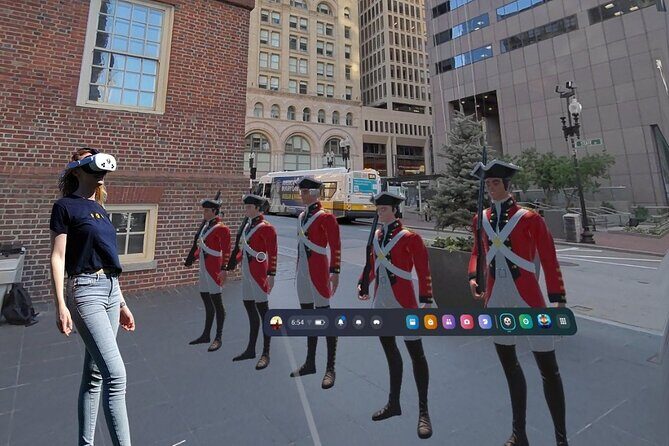
- AR, not VR: you keep seeing the real world, so you avoid the VR-style nausea concern
- Small group size: capped at 8 people for a more guided feel
- Fixed story arc: key Revolutionary-era moments from 1765–1775, ending at Bunker Hill
- Multiple device options: Meta Quest AR headsets, plus tablets for tablet-based AR moments
- Short, punchy scenes: each experience is about 5–15 minutes, usually with a 1-minute video
- A souvenir tied to the theme: a reusable Illegal Tea tea bag plus a discount card
Freedom Trail, but with AR history on top
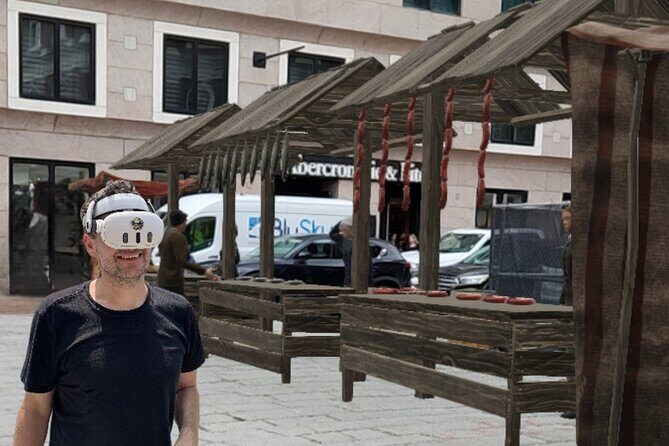
The Freedom Trail already does something special: it’s a walking route through Boston where you can line up today’s streets with the events that changed America. Relive 1776 adds a new layer. Instead of only imagining what happened, you watch short scenes play at the exact places connected to the Revolution.
This is built around a 5-part AR experience that tracks key years from 1765 to 1775, with a guide walking you from site to site. The format is designed to keep you moving and engaged. You’ll meet Revolutionary figures in AR at Boston Common under the Great Elm Tree, including Paul Revere, John Hancock, and Samuel Adams, then keep going as the story builds toward the founding of America.
If you’re the kind of person who gets bored on long lectures, you’ll probably appreciate the pacing. Each AR station is brief, and most of the “heavy lifting” (what you’re looking at and why it matters) is explained right there, on the spot.
You can also read our reviews of more historical tours in Boston



The 2-hour walking format (and why it matters)
The tour clocks in at about 2 hours. That’s long enough to cover a meaningful chunk of the Freedom Trail, but not so long that you feel stuck. The experience is spread across stops that include Boston Common and Granary Burying Ground, plus points like the Statue of Benjamin Franklin and Old State House, and then it moves along toward Faneuil Hall Marketplace, the Paul Revere House, and finally Bunker Hill.
Here’s why that timing matters for your enjoyment: the AR scenes are short (5–15 minutes each). You’re not waiting around for a long projection. You get a scene, you get the explanation, and then you walk to the next one.
It also helps explain the ticket price. At $30 per person, you’re paying for a guided, technology-supported tour with equipment (headsets and tablets) plus the themed “Illegal Tea” souvenir. You’re not just buying content on your phone. You’re getting a staffed experience that’s built to happen outside, on a sidewalk, where most history apps can’t handle the storytelling nearly as well.
How you’re set up with headsets and tablets
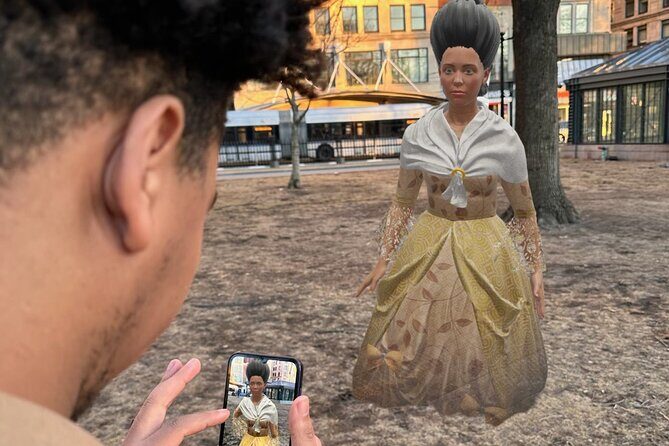
Relive 1776 uses Meta Quest AR headsets for the AR scenes, and it also provides tablets so you can do the AR experiences without wearing the headset the whole time. The tour is careful about the big concern people have with immersive tech: nausea.
The key difference is that it’s AR, not VR. With AR, you can see the real world at all times while the historical layer appears. That means you’re not turning your surroundings into something completely artificial. You’re staying on the sidewalk, and the tech supports the moment instead of replacing it.
In practice, this makes the tour friendlier for people who are curious about AR but cautious about VR. It also means you can choose what feels comfortable for you at each station—headset at one stop, tablet at another—depending on how you’re doing that day.
Stop by stop: from Boston Common to Bunker Hill
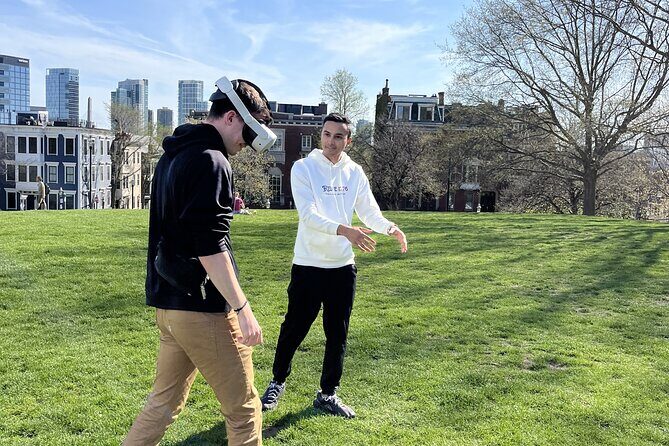
This tour follows the Freedom Trail, but it does it with staged “time travel” moments. Some stations are more about the narrative guide walking you through what matters. Others are AR scenes where you watch (and sometimes interact) with short historical vignettes.
Boston Common: The Great Elm and meeting Revolutionary leaders
You start at the Boston Common Visitors Center on Tremont Street. Your first major AR moment connects the political tension of the early Revolution to place and timing.
Under the Great Elm Tree area, the AR experience guides you through meetings with Paul Revere, John Hancock, and Samuel Adams. If you’ve never had those names anchored to a physical spot, this is where they click. You’re not just hearing about them in the abstract—you’re standing near the civic space where Revolutionary energy gathered.
This is also a good place for the first “wow.” It sets expectations fast: history will appear in front of you, in the real setting, and you’ll keep moving as the story unfolds.






Granary Burying Ground and the Boston “who’s who” feeling
After Boston Common, you head to Granary Burying Ground. The guide uses the site to connect names, timing, and consequences. Even if you’re not a graves-and-monuments person, this stop helps you understand why Boston legends became permanent: the people are remembered right here.
This part of the route isn’t only about facts. It’s about context. The AR and guide together help you connect the Revolution’s political stakes to the humans who lived those stakes.
Benjamin Franklin statue and the power of everyday ideas
Next comes the Statue of Benjamin Franklin. This is one of those stops that can be either forgettable or memorable depending on what you do with it. Relive 1776 leans into the “why” side—what Franklin represented and how ideas traveled through Boston’s public life.
Think of this station as a bridge: it’s not just action scenes. It’s also about the thinking behind the actions.
Old Corner Bookstore and the revolution of print
You then move toward Old Corner Bookstore, another Freedom Trail landmark tied to how information spread. The tour uses AR to keep you from treating the building like a backdrop.
Instead of only looking at the structure, you’re guided through what made print, persuasion, and communication matter during 1765–1775. If you like history that explains systems—how messages moved, how arguments formed—this stop is a good fit.
Old State House: conflict gets real
Old State House is where the story tightens. The Freedom Trail route often uses this area to explain governance and public conflict. In this tour, the AR moments keep the energy up while the guide walks you through what was happening around that time window.
This is also a key point for your pacing mindset. Because AR scenes are short, you’ll want to stay present. Look at what the guide points out, then watch what appears. It’s easier than it sounds if you treat it like a living lesson, not a museum audio tour.
Faneuil Hall Marketplace: the public stage
Faneuil Hall Marketplace is famous because it was a public stage. Here the guide keeps tying the Revolution to civic action, not just battlefield drama.
You get another “on the spot” feeling: the place looks like itself, but the story layer changes what you notice. It can help you understand how public gatherings mattered, and why Boston’s debate culture was part of the push toward independence.
Paul Revere House: the human scale of the mission
As you move to the Paul Revere House area, the tour focuses on the people behind the legend. The arc builds toward the night rides and conflict that come later.
This stop is a favorite moment for many because it turns a famous name into a scene you can visualize. And because the tour uses AR, you’re not just told a sequence—you’re guided through a moment in the timeline.
Bunker Hill ending: the finale where walking stops
The last experience ends at Bunker Hill, where the walking tour finishes. By this point, you’ve built momentum through the 1765–1775 sequence, so the ending lands with more weight than if you just started with battles.
It’s also the type of ending that feels like payoff: you get a story closure while standing at one of the most famous Revolutionary sites in Boston.
The story beats: what you’ll actually learn
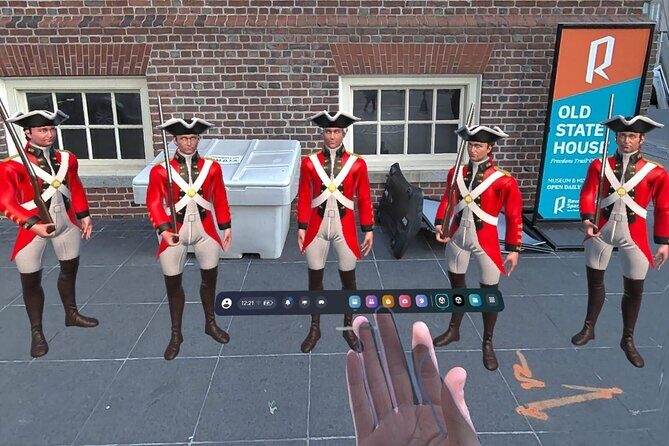
Relive 1776 doesn’t just “show” you history. It sets up a sequence where key Revolutionary moments add up to the founding of America.
Along the way, you’ll see AR experiences that range from playful to intense, but the tour is clear about one thing: there’s no gore. It’s educational and fun, not graphic.
Some experiences are more interactive than others. In at least one scene, the AR layer can place you in the middle of an action view—like a cart and horse ride passing through your viewpoint—quick, strange in the best way, and designed to be short.
Other experiences focus on skills and visuals: trying on colonial fashion and operating a historically accurate field cannon moment are both part of the wide range of AR events. That variety is smart. It keeps the tour from becoming one repeated type of “look at the screen” moment.
Price and value at $30 for a guided AR Freedom Trail
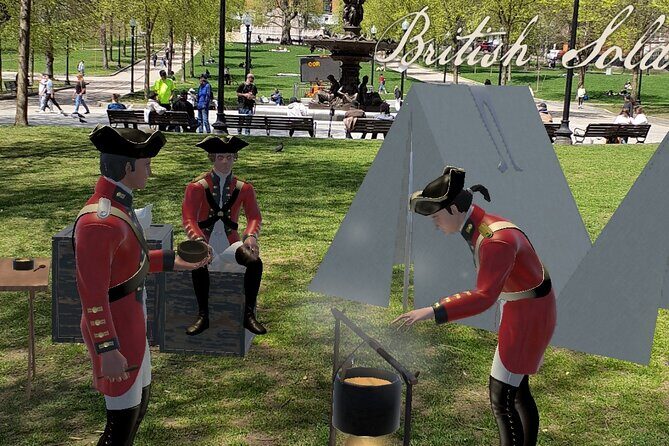
Let’s talk value without hype. At $30 per person, the price makes sense if you compare what you’re getting:
- A guided tour (English only) with live storytelling
- AR equipment: Meta Quest headsets and tablets
- A multi-stop walk across major Freedom Trail sites
- A themed souvenir: a reusable Illegal Tea tea bag and a discount card
- Group size limited to 8 travelers, so it doesn’t feel like a conveyor belt
If you were to pay for separate guided tours of each stop, you’d likely spend more. And if you were to use a self-guided AR app on your own, you’d lose the context and “on-site help” that keeps the tech working and the story making sense.
Yes, you’ll still be walking and standing outside. This isn’t a sit-down classroom. But that’s part of the payoff: you get to connect Revolutionary-era events to real locations right where they happened.
Who this tour fits best (and who might not love it)

This tour is a great match if you want:
- A Freedom Trail experience that’s not only facts, but also actionable scenes
- AR tech you can use without VR-style nausea worries
- A guide who helps you connect sites to story beats
- A format that works for kids and adults (one guide is specifically praised for making AR easy)
It may be less ideal if you:
- Want a heavy, detail-dense lecture where you can linger long at each site
- Dislike built-in video/audio narration inside the AR experiences
- Prefer fully free-form sightseeing without a set sequence
In other words, I’d treat this like a “guided history + tech show” more than a traditional walking tour.
Quick practical tips so you get the most out of it

A few small things can make a big difference:
- Plan to arrive ready to start from Boston Common Visitors Center (139 Tremont St). The tour starts there and ends back at the meeting point.
- Bring patience for the tech flow. AR stations are short, so you’ll benefit from watching the guide’s instructions early.
- If an AR station includes video/audio narration in the experience, don’t skip it. The tour’s story depends on it.
- Wear what you’d wear for a couple of hours of walking along the Freedom Trail, since the route covers multiple stops.
- Service animals are allowed, and the meeting point is near public transportation—helpful if you’re stitching this into a day of Boston sightseeing.
Should you book Relive 1776?
I’d book it if you like your history with a modern twist and you want the Freedom Trail to feel immediate, not distant. The combination of a live guide plus AR scenes at real locations makes the story more memorable than a brochure route.
Skip it (or at least think twice) if you know you’ll tune out the station narration, or if you prefer long, unstructured time at each site. Since the tour is built around specific AR moments and a timed flow, your enjoyment will rise or fall with your willingness to participate.
If you want a fast, high-impact way to see Boston’s Revolutionary-era landmarks in a single outing, Relive 1776 is a strong bet—especially at $30 for a guided, technology-supported route with a small group cap.
FAQ
FAQ
How long is the Relive 1776 AR tour?
It runs for about 2 hours on average.
What does the tour include?
You get an English-only tour guide, Meta Quest AR headsets, tablets for AR experiences, and the Illegal Tea reusable tea bag souvenir with a discount card.
Is this VR or AR?
It’s AR (augmented reality), not VR. You’ll see the real world at all times during the experiences.
What stops are included?
The tour starts at Boston Common and includes stops along the Freedom Trail such as Granary Burying Ground, the Benjamin Franklin statue area, Old Corner Bookstore, Old State House, Faneuil Hall Marketplace, and the Paul Revere House, with the final experience ending at Bunker Hill.
How big is the group?
The tour has a maximum of 8 travelers.
Do I need transportation to the meeting point?
No transportation is included. You’ll need to make your own way to the meeting point at Boston Common Visitors Center (139 Tremont St, Boston, MA 02111).
Can I cancel for free?
Yes. You can cancel for a full refund up to 24 hours before the experience start time.