REVIEW · BOSTON
Downtown Freedom Trail Walking Tour – History & Architecture
Book on Viator →Operated by Boston CityWalks · Bookable on Viator
Freedom Trail hits you fast on foot. This Downtown Freedom Trail tour threads major turning points into real Boston Common-area architecture with a guide who keeps the story moving.
I love the tight pacing: in about 1 hour 10 minutes you cover a long stretch of downtown landmarks without feeling rushed. I also love the small-group feel (max 20), which makes it easier to ask questions and catch details. One thing to plan for: on busy sidewalks, the guide may be harder to hear unless you stay closer to the front.
In This Review
- Key things to know before you go
- Walking the Freedom Trail from Faneuil Hall to the New State House
- Price and value: $45 for a 70-minute history lesson
- The route in plain terms: where you start and where you end
- Stop-by-stop: what you’ll see from Faneuil Hall to Boston Common
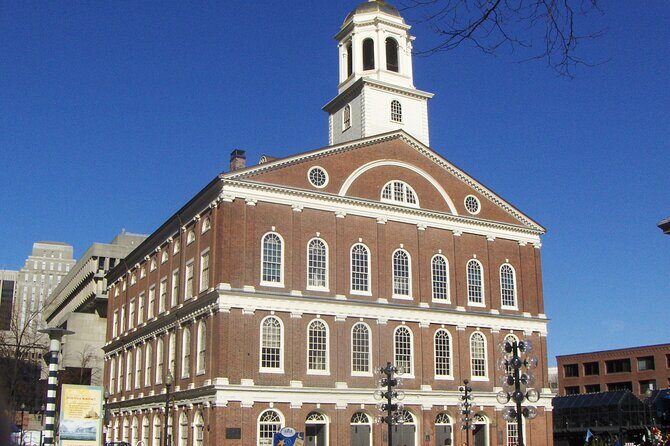
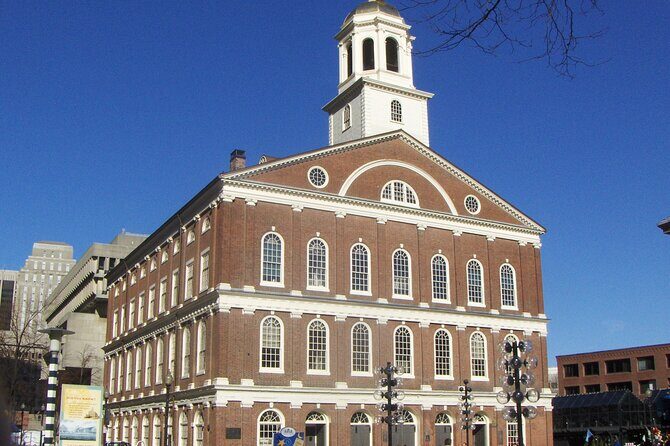
- Faneuil Hall Marketplace: the “Cradle of Liberty” moment
- The Boston Massacre site: the spark on cobblestone
- Old State House: power you could hear from the balcony
- Old South Meeting House and Old Corner Bookstore
- King’s Chapel: centuries of change in one church
- The Tea Party signal church: where action got organized
- Irish Famine Memorial: history after the revolution
- Old City Hall: civic power in French Second Empire form
- Boston Latin School: the first public school
- King’s Chapel area meets memorial and city park
- Boston Common: the oldest city park in the US
- New State House and the gold dome overlook
- Architecture vs. history: how the tour keeps both connected
- Group size, comfort, and weather: what to do before you meet
- Who should book this Freedom Trail walking tour
- Should you book Downtown Freedom Trail: History & Architecture?
- FAQ
- FAQ
- How long is the Downtown Freedom Trail walking tour?
- What does the tour cost?
- Where does the tour start and end?
- What time does the tour begin?
- Is the tour offered in English?
- Do I get a mobile ticket?
- How big is the group?
- Does it run in bad weather?
- Is it suitable for families and kids?
- Can I cancel for a full refund?
Key things to know before you go
- Small group, big access: up to 20 people, so you’re not lost in a crowd of 60.
- Major stops in one run: Faneuil Hall area, Old State House, Park Street Church, King’s Chapel, Old Granary Cemetery, and Boston Common.
- Architecture as a story tool: you’ll connect what you see (churches, civic buildings, meeting houses) to what happened.
- Good outdoors time: it runs in all weather, so dress for rain or cold and you’ll still enjoy it.
- A guide who uses humor: several guides (including Alan and Andrew, per guest feedback) keep the lesson lively.
Walking the Freedom Trail from Faneuil Hall to the New State House
Boston’s Freedom Trail is famous for a reason: it’s one of the easiest ways to understand how the United States got its early rhythm. This tour is built for people who want the story plus the physical setting, not just a checklist of sites.
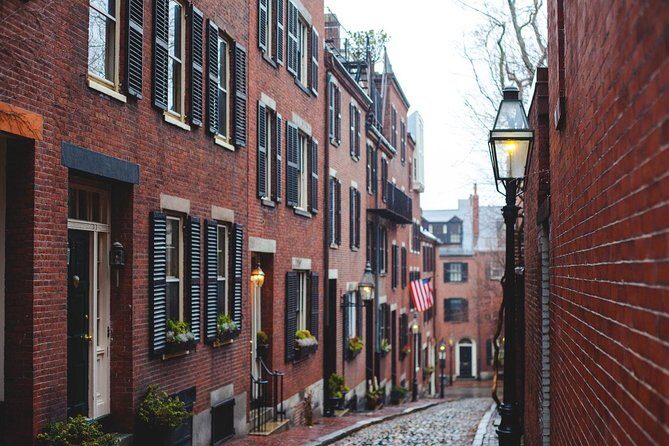
You start in the financial-and-old-town zone at State Street and Congress Street at 10:00 am, then you work your way toward Boston Common, where the civic nerve center of the city overlooks the whole scene. The route is downtown, so expect classic city sidewalks, quick turns, and moments where you pause and look up to see what the buildings were built to communicate—power, protest, faith, and community.
A guide is the main difference here. Without a guide, you can absolutely follow the red line and read plaques. With a guide, you get a line of cause and effect: events connect to specific buildings, and the buildings connect to how Bostonians lived and organized long before the fireworks of revolution.
You can also read our reviews of more walking tours in Boston


Price and value: $45 for a 70-minute history lesson
At $45 per person, this isn’t a “pay a little for a quick stroll” kind of deal. It’s closer to paying for a compact, guided walking lecture that packs in a lot: multiple landmark interiors-at-a-glance, architecture cues, and story context.
What makes the price feel fair is the mix of:
- Guide time (professional narration for roughly 70 minutes)
- Focused coverage of a dense downtown corridor
- Landmark access built into the experience, including major stops like Faneuil Hall, King’s Chapel, and Boston Common
You’re also not stuck waiting in transit. The whole point is that this is walkable downtown, so you trade car or train time for foot time. If you’re visiting for the first time, or you’re short on hours but still want the “why” behind the “what,” this price lines up with what you’re really buying: guided interpretation.
The route in plain terms: where you start and where you end
The tour starts at State Street at Congress Street, Boston, MA 02203, and ends at Brewer Fountain, Freedom Trl, Boston, MA 02108. That ending matters. Boston Common is not just a park—it’s the place you can immediately expand your day: grab a snack nearby, continue exploring the city, or connect to other walks.
During the walk, you’ll move through a cluster of historic sites that represent different roles in colonial and early national life:
- markets and public protest
- courts and government
- churches and community gathering spaces
- schools and learning
- cemeteries and memory
- civic power and modern government
Because it’s roughly 1 hour 10 minutes, you should plan to arrive a few minutes early. If you’re late, you’ll spend the first few minutes catching up while the group is already rolling.
Stop-by-stop: what you’ll see from Faneuil Hall to Boston Common
The best way to understand this tour is to treat each stop like a chapter. Some stops are about protest. Some are about governance. Others are about the institutions that shaped daily life.
Faneuil Hall Marketplace: the “Cradle of Liberty” moment
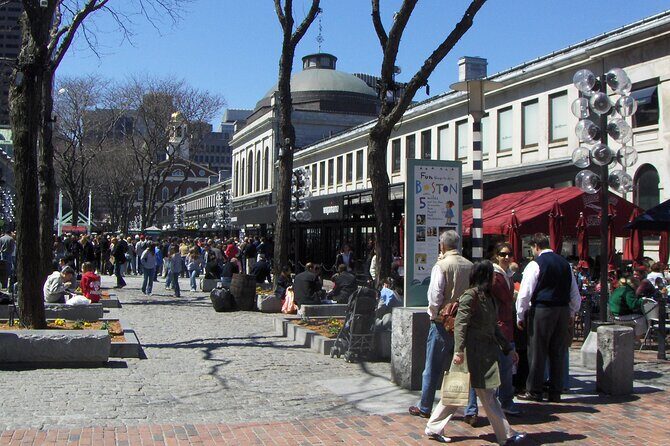
You begin in the area of Faneuil Hall, tied to the “Cradle of Liberty” nickname. This is where the marketplace energy turns into political action—speeches, heated arguments, and the kind of public pressure that makes governments listen.
A fun detail to watch for is the grasshopper weathervane. Look up when you can. Those little visual cues are part of what helps the buildings stick in your mind later.
You can also read our reviews of more historical tours in Boston





The Boston Massacre site: the spark on cobblestone
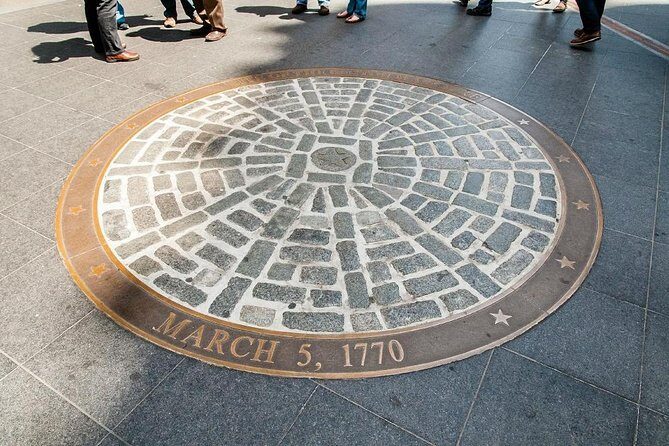
Next comes the Boston Massacre area, marked by a cobblestone ring in the pavement at the exact spot where the 1770 skirmish between Redcoats and colonists ignited the rebellion spirit.
This is one of those moments where the geography matters. You’re not just hearing about tension—you’re standing where it began to feel like something bigger than an argument.
Old State House: power you could hear from the balcony
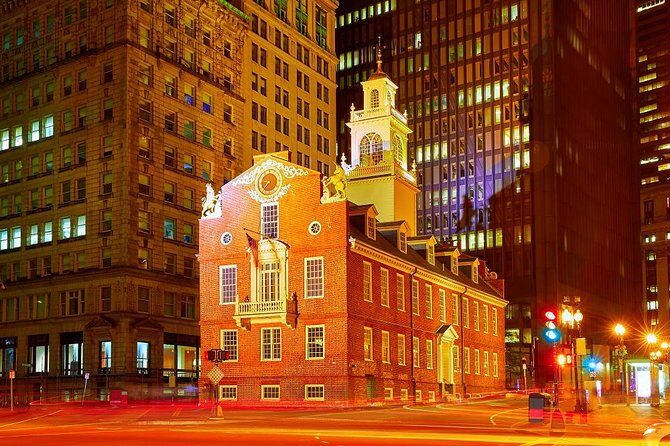
The Old State House (built 1713) is a cornerstone stop. This building served as the seat of British colonial government, and it’s tied to a major civic moment: the Declaration of Independence was first read to Bostonians from its balcony.
What to pay attention to here is the building’s purpose. When a government reads something publicly from a prominent balcony, it’s sending a signal about authority and legitimacy. In other words, this isn’t only about history—it’s about how power communicates.
Old South Meeting House and Old Corner Bookstore
You’ll also see the Old South Meeting House, a key gathering space (and historically linked to the push toward revolution).
Then you move to the Old Corner Bookstore at 283 Washington Street at the corner of School Street. Built in 1718 as a residence and apothecary shop, it later became a bookstore in 1828. It’s especially famous because authors like Ralph Waldo Emerson and Charles Dickens once gathered there.
If you like your history with a human side, this is a good pivot. It reminds you that revolutions don’t happen only in shouting crowds. They also happen in rooms where ideas get shared, refined, and passed along.
King’s Chapel: centuries of change in one church
King’s Chapel is a stop with layers—more than 330 years of history, from its founding in 1686 through revolution and into today’s Boston.
It’s also unique because its story spans multiple eras without being trapped in one narrow theme. If the tour brings you to a place where you’re listening for religion, politics, and cultural change at the same time, this is where that blend becomes real.
The Tea Party signal church: where action got organized
You’ll visit the massive brick church tied to signals used to start the Boston Tea Party in 1773. The key value of this stop is the reminder that large events often depend on communication networks and timing, not just courage.
Irish Famine Memorial: history after the revolution
Between Washington Street and School Street sits the Boston Irish Famine Memorial. It uses two groups of statues to contrast an Irish family suffering during the Great Famine of 1845–1852 with an Irish family that later immigrated and found prosperity in America.
This stop changes the tone in a useful way. It broadens the idea of “Boston’s history” beyond the revolution era and shows how the city kept absorbing new waves of hardship and hope.
Old City Hall: civic power in French Second Empire form
The Old City Hall at 45 School Street once housed the Boston City Council from 1865 to 1969. Designed by Gridley James Fox Bryant and Arthur Gilman, it’s noted as one of the early examples of French Second Empire style in the United States.
Even if you’re not a big architecture person, the value here is clear: city government has always used buildings to project stability and importance. The style isn’t just decoration. It’s communication.
Boston Latin School: the first public school
Another standout is the site tied to the Boston Latin School, founded April 23, 1635. This is described as the first public school in America, originally on School Street, offering free classical education to boys.
Look for the statue of Benjamin Franklin and a sidewalk mosaic marking the original site. This is a powerful reminder that education was part of the early civic mission, not an afterthought.
King’s Chapel area meets memorial and city park
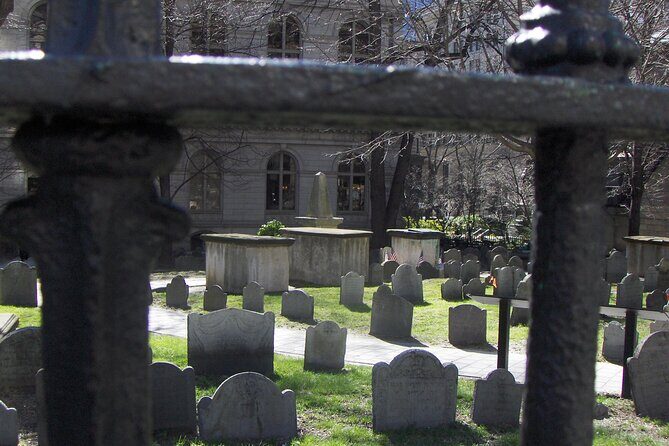
From there, the tour moves you toward major public spaces and memory spots, including the final resting place of Paul Revere, Samuel Adams, and John Hancock at Old Granary Cemetery—one of the most visited cemeteries in the country.
Then you land in the heart of daily life: Boston Common.
Boston Common: the oldest city park in the US
Boston Common is the oldest city park in the United States and covers 50 acres, bordered by Tremont Street, Park Street, Beacon Street, Charles Street, and Boylston Street.
This is more than a pretty park stop. It helps you understand the city’s early layout: where public gatherings could happen, where space was reserved for community, and how the civic center stayed walkable and central.
New State House and the gold dome overlook
Finally, you see the new State House built in 1798, famous for its 23-karat gold dome. It serves as the modern seat of government and overlooks Boston Common.
This ending ties the story together. You began with colonial government power and ended with government power still in motion. It makes the arc from “then” to “now” feel real.
Architecture vs. history: how the tour keeps both connected
This tour has a special angle: it doesn’t treat architecture as wallpaper. It uses buildings as evidence.
Here’s the practical payoff. After the tour, you’ll likely start noticing things on your own walk:
- why some structures look formal and official
- how meeting houses and churches signaled community roles
- why schools and civic buildings were placed where they were
- how public spaces like Boston Common shaped gathering and protest
That’s also why guide style matters. Feedback highlights that guides like Alan and Andrew mix humor with explanation, and they work to connect storylines through architecture. One downside that pops up occasionally is that in the middle of street noise, some people want louder audio or a microphone. So keep close, and don’t be shy about asking the guide to repeat or clarify in a quieter moment.
Group size, comfort, and weather: what to do before you meet
This walk caps at 20 people, and that’s a real quality-of-experience factor. With a smaller group, you usually get better sightlines and more chances to ask questions.
It also operates in all weather conditions, so bring real-world gear:
- wear comfortable shoes (you’re walking downtown for more than an hour)
- bring a rain layer if skies look questionable
- dress in a way that lets you stand in one spot and listen without freezing or steaming
One more comfort tip: since you end near Brewer Fountain and finish around the park edge, plan your next stop nearby. It makes your day feel smooth instead of fragmented.
Who should book this Freedom Trail walking tour
This fits best if you want:
- a first-time Boston orientation focused on the revolution era and the institutions behind it
- a short time window (roughly 70 minutes) but still want meaningful stops
- a guided walk that connects history to specific buildings
- something that works for families, since kids are allowed as long as they’re with an adult
It’s also a strong choice if you like humor in your education. Many comments mention that guides bring energy and make history easier to remember.
If you’re the type who wants one strict thread with almost no detours, you should know that the tour may include broader social context beyond the headline events. That kind of framing can be helpful, but if you’re expecting only the most standard founding-era story, consider whether this matches what you came for.
Should you book Downtown Freedom Trail: History & Architecture?
If you want an efficient, walkable way to understand Boston’s revolutionary-era story and see why the buildings look the way they do, I’d book it. The route hits major landmarks you’d want to see anyway—Old State House, King’s Chapel, Boston Latin School area, Old Granary Cemetery, and Boston Common—and the guide turns those stops into a connected narrative instead of separate photos.
I’d especially recommend it if you value:
- a small-group experience
- a guide who uses humor and clear storytelling
- a dose of architecture + context in one go
Hold off only if hearing audio is your top concern and you tend to struggle in loud public settings—in that case, position yourself closer to the guide and be ready for outdoor street sound.
FAQ
FAQ
How long is the Downtown Freedom Trail walking tour?
The tour runs about 1 hour 10 minutes.
What does the tour cost?
It’s $45.00 per person.
Where does the tour start and end?
It starts at State Street at Congress Street, Boston and ends at Brewer Fountain on the Freedom Trail.
What time does the tour begin?
The listed start time is 10:00 am.
Is the tour offered in English?
Yes, it’s offered in English.
Do I get a mobile ticket?
Yes, the experience includes a mobile ticket.
How big is the group?
The maximum group size is 20 travelers.
Does it run in bad weather?
It operates in all weather conditions, and you should dress appropriately. If it’s canceled due to poor weather, you’ll be offered a different date or a full refund.
Is it suitable for families and kids?
Most people can participate, and children must be accompanied by an adult.
Can I cancel for a full refund?
Yes. You can cancel up to 24 hours in advance for a full refund.