REVIEW · BOSTON
2 Hour Boston Historical and Heritage Walking Tour
Book on Viator →Operated by Boston Free Walking Tours · Bookable on Viator
History in Boston, told street by street. This 2-hour Boston Historical and Heritage Walking Tour is a low-cost way to get the big-picture story fast, while also hearing the kinds of details that don’t show up in most guidebooks. I especially like the Boston Common opener and how questions come up naturally as you walk. One thing to plan for: the pace is information-heavy and can feel brisk, especially in wind, rain, or noisy street conditions.
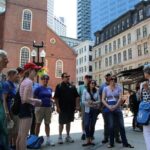
I’ve found this kind of small-group format to be the sweet spot for sightseeing with strangers: you socialize a bit, but you still get real back-and-forth with the guide. The tour is run in English and starts at Boston Common, using a mobile ticket. Each stop is set up for quick viewing and short explanations, so you’ll leave with a clearer mental map of the city’s past.
You meet at the Boston Common Tablet on Freedom Trail (1634 Freedom Trl) and finish at the James Michael Curley statues at Congress St @ North St—basically across from Faneuil Hall. It’s about a mile of walking over roughly 2 hours, with no paid entry required at the listed stops. The experience depends on good weather, so on cold or rainy days, dress for it.
Key things that make this tour worth your time
- Small group size (max 24) so the guide can keep track of questions without feeling rushed.
- Boston Common to Faneuil Hall route that ties the Revolution, religion, and civic life into one walk.
- Stephen’s storytelling style—lots of human details and practical explanations that stick.
- Quick photo moments at major landmarks like the Common and the State House dome.
- Noise-aware guiding (the guide has used a voice amplifier to be heard around street distractions).
- Real timelines and names: Samuel Francis Smith, Robert Gould Shaw, Mary Dyer, Peter Faneuil, and more.
In This Review
- Boston Common to the Freedom Trail core in just two hours
- Boston Common and Park Street Church: the city’s meeting place
- Shaw Memorial and the Massachusetts State House: courage and controversy
- The “Brahmins” library stories and Scollay Square’s lost world
- Old State House, Boston Massacre, and the Tea Party plan
- Irish Famine remembrance, Old Corner Bookstore, and Boston Latin School
- From Faneuil Hall’s Liberty to City Hall’s real politics
- How the pacing and noise work on a real Boston street
- Should you book this Boston Historical and Heritage Walking Tour?
- FAQ
- How long is the Boston Historical and Heritage Walking Tour?
- What does the tour cost?
- Where do I meet, and where does the tour end?
- Is the tour offered in English?
- Do I need to pay admission fees at the stops?
- Is there a limit on group size?
- Can I use a mobile ticket, and is the tour near public transportation?
- What happens if the weather is bad, or I need to cancel?
Boston Common to the Freedom Trail core in just two hours
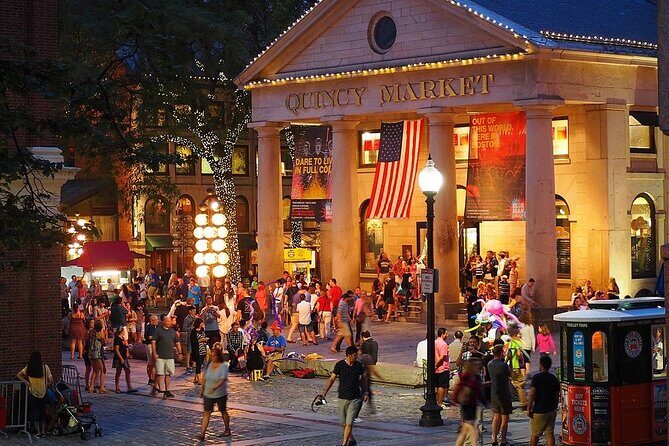
If you want a guided “orientation shot” at the start of a Boston trip, this works. The route runs through some of the city’s best-known symbols—then adds the supporting cast: abolitionist meetings, Civil War heroism, Puritan-era planning, and the cultural power of elite Boston families. You’re not just collecting famous spots. You’re learning how Boston argued with itself, protested itself, and reinvented itself, generation after generation.
At $5, this isn’t about paying for museum tickets. It’s about paying for a guide who can connect dots. The best value here comes from the fact that you don’t need to choose between history and logistics. Everything is close enough to keep moving, but each stop is timed for you to absorb the point and take a photo before the next scene begins.
One practical note: the tour packs a lot into a short window. Many stops are brief, which is great for first-timers—less great if you want long pauses, deep reading, or lots of quiet. If you’re the type who likes to linger, you can still do it, but you’ll likely need to do it after the tour ends.
Finally, consider timing. It starts at 11:00am. If you’re a morning person who hates losing daylight, that’s a plus. If you prefer later in the day, you might find the route coincides with colder afternoon streets if the weather turns.
Boston Common and Park Street Church: the city’s meeting place
The tour begins at Boston Common, and it’s a strong first move because the Common is more than a park. It’s a record of Boston’s changing priorities. You’ll hear how it served colonial-era functions—military drills and public punishments—and how it later became a place for strolling under the elms. That shift, from public order to public leisure, is the kind of contrast that makes Boston feel different from other American “Old City” stops.
From the Common, you head to Park Street Church, a key stop if you care about the moral battles that shaped the 1800s. This church is tied to the abolitionist movement and missionary energy of the time. You’ll also hear about a music-and-history moment: the debut of My Country, ’Tis of Thee (also known as America) by Samuel Francis Smith on July 4, 1831.
What I like about these two opening stops is that they show how Boston’s public spaces worked like stages. Protest, politics, and identity weren’t confined to speeches in a hall. They happened where people gathered. That helps you understand why later sites—memorials, government buildings, and revolutionary meeting points—feel so alive.
Possible drawback? If you’re sensitive to crowds or you don’t like standing close while others take pictures, the Common can feel busy. You’ll still get your turns, but you’ll want comfortable shoes and a quick grip on your photo strategy early.
You can also read our reviews of more walking tours in Boston

Shaw Memorial and the Massachusetts State House: courage and controversy
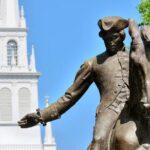
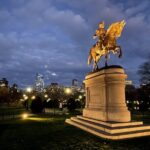
Next up is the Robert Gould Shaw and the 54th Regiment Memorial. This is one of those stops that changes how you think about the Civil War, because it forces you to focus on people rather than dates. You’ll hear about the 54th Massachusetts Infantry—one of the early African American units—and the courage tied to their story. It’s a memorial, but it’s also a reminder that Boston’s history includes both civic pride and real struggle.
Then you move to the Massachusetts State House, anchored by that famous golden dome. Even if you’ve seen it in photos, it hits differently in person because it’s still functioning as a seat of government. You’ll learn it’s been the legislature’s home since 1798, and you’ll also notice the statues tied to controversy and protest.
Two names matter here: General Joseph Hooker (often remembered for a less flattering legend) and Mary Dyer, hanged for her Quaker beliefs. That’s the point: Boston wasn’t just building laws and institutions. It was deciding who counted as acceptable. Hearing those stories next to the beauty of the architecture gives you a more honest sense of what “civic life” meant.
This section is also a good place to ask questions. The guide tends to answer in a way that connects to earlier themes—religion, public pressure, and who got power. If you’re traveling with kids, this is also a natural “pause and talk” zone because the characters are vivid.
One consideration: this part of the walk is outdoors in city air. If it’s windy, plan on layers. A lot of small-group history tours are fine until the weather starts acting up, and Boston can switch moods quickly.
The “Brahmins” library stories and Scollay Square’s lost world
Between the grand government sights, you’ll get stories that feel more personal—Boston’s intellectual and social elite, and the cultural entertainment that shaped street life. One highlight is the story around the Private Library of the Brahmins, described as a hidden gem with rare and valuable books. Even if you can’t spend time reading inside, hearing what these collections represented helps explain how ideas moved through Boston’s upper circles and how intellectual life influenced broader American thought.
Then the mood shifts toward West End and Scollay Square. You’ll hear how this area was known for theaters, vaudeville shows, and characters that made the neighborhood feel alive—sometimes chaotic. It’s not just nostalgia. The point is how Boston’s entertainment districts fit into the city’s larger identity: art, politics, and social life interlocking in the same streets.
You may also get a stop for a “Love Nest” story tied to the Kennedys—an intriguing pop-cultural footnote that makes the past feel less like a textbook. If you’re interested in how famous families get mythologized by place, this is the kind of detail that makes the walk more fun.
One drawback to keep in mind here is time. These stops are short by design. If you love urban photography, you may want to prioritize your best shots at places like the Common, the State House dome, and the major revolutionary stops later on. Scollay Square moments are more about storytelling than lingering.
Old State House, Boston Massacre, and the Tea Party plan
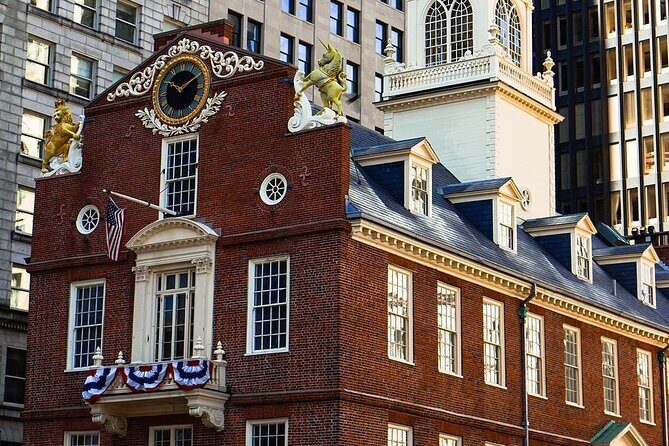
The most dramatic stretch comes next, because Boston’s revolutionary timeline shows up in real locations. You’ll stand in the shadow of the Old State House and hear why it matters. Key events took place there, including the reading of a copy of the Declaration of Independence to Boston citizens in 1776.
Then you’ll hear a fascinating restoration story. When the building fell into disrepair toward the end of the nineteenth century, the city of Chicago reportedly offered to buy it. Boston wasn’t willing to lose it, and the restoration became a civic rescue effort—meticulously salvaged and brought back.
After that, you go to the Boston Massacre site. The confrontation between British soldiers and American colonists is told as a chain reaction: what happened, why it mattered, and how it helped push sentiment toward revolution. These moments can be heavy, but they’re easier to carry when the guide explains the cause-and-effect.
Finally comes the Tea Party moment in the story of the tea crisis. You’ll hear about December 16, 1773, when five thousand citizens gathered and agreed to prevent the British tea ships’ cargo from landing. You’ll also hear about the group of men disguised as Mohawk Indians who led the mob down Milk Street to Griffin’s Wharf for the Tea Party—turning political planning into public action.
This trio of stops is where the tour’s value really shows. You don’t just get a list of historic events. You get a sense of how Boston crowds formed, how decisions got made in public, and how symbolism turned into momentum.
If you’re traveling in cold weather, this is also where you’ll appreciate the guide’s ability to keep moving. Just remember: with all the emotion here, it’s easy to lose track of time. If you want extra context later, take quick notes on your phone at the Massacre and Tea Party stops so you don’t forget the thread.
Irish Famine remembrance, Old Corner Bookstore, and Boston Latin School
The tour slows just enough to make space for memory and education. You’ll visit the Boston Irish Famine Memorial, a poignant stop honoring thousands of Irish immigrants who fled the Great Famine of 1845–52 and found refuge in Boston. The story matters not only because it explains a major wave of newcomers, but because it shows how immigration reshaped the city’s identity. The memorial also notes that by 1850, Irish immigrants became Boston’s largest ethnic group, and it serves as a tribute to immigrants generally.
Then you head to Old Corner Bookstore, one of those places where Boston’s writing culture isn’t abstract—it’s embedded in brick. The building began as a residence and apothecary in 1718, became a bookstore in 1828, and for three decades housed Ticknor and Fields publishers. It was a meeting place for famous authors like Henry Wadsworth Longfellow, Nathaniel Hawthorne, Oliver Wendell Holmes Sr., and Ralph Waldo Emerson.
This stop is a fun switch if you’ve been hearing war and politics all morning. It reminds you that Boston’s influence includes the ideas printed on paper, read in parlors, and argued about in public spaces.
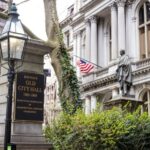
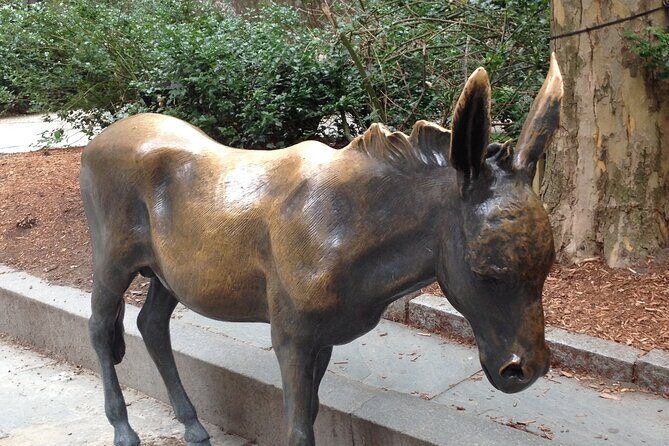
Next is Boston Latin School on School Street, tied to the claim of being the site of the first public school in the United States. You’ll also pass by or hear about landmarks nearby like King’s Chapel, Old City Hall, and the Parker House. And yes, there’s a donkey—Boston’s favorite “patient observer”—waiting on School Street.
If you’re bringing kids or teenagers, this is a smart section. It’s interactive without needing a museum ticket, and it gives the day a lighter, curious rhythm.
Practical consideration: these educational and bookstore stops are short. If you want to shop, browse, or linger, plan for it after the walk. The guide’s focus is on stories and connections, not extended time inside.
You can also read our reviews of more historical tours in Boston





From Faneuil Hall’s Liberty to City Hall’s real politics
The finale is Faneuil Hall Marketplace, often called the cradle of liberty in American memory. You’ll hear about the grasshopper weathervane on the building and how it’s believed to be modeled after London’s Royal Exchange style. You’ll also hear why it earned its symbolic role as a gathering place for revolutionary leaders.
There’s also an uncomfortable detail that keeps the story honest: the hall was gifted to Boston by Peter Faneuil, described as a slave trader. It’s a reminder that American ideals and American business history often overlap in messy ways.
You’ll also get a civic twist that many first-time visitors miss. Faneuil Hall is headquarters of The Ancient and Honorable Artillery Company of Massachusetts, described as the oldest military body in the Western Hemisphere, with a charter dating to 1837. That fact gives you another lens on the city: Boston’s identity includes militia traditions as well as debates about freedom.
The tour ends at Boston City Hall, in the shadow of the statues of James Michael Curley—four-time mayor, governor of Massachusetts, and congressman. The guide connects him to big-city politics, including his long influence as a “boss” figure. It’s fitting. The walk starts with public assembly and ends with a reminder that power and performance still matter.
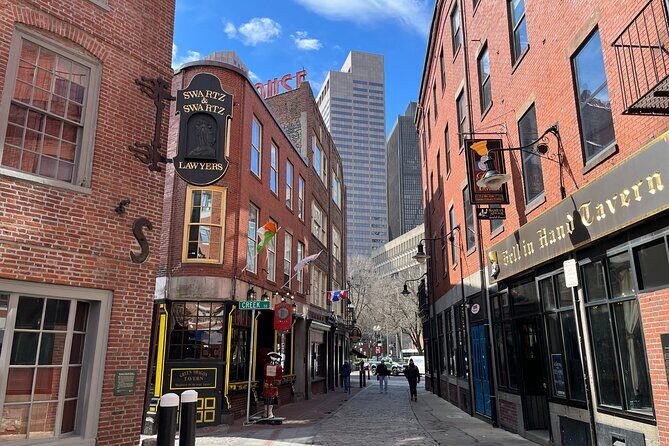
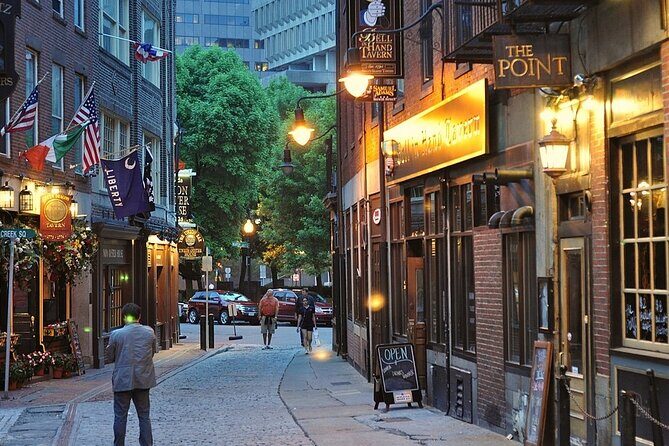
One practical tip for after the tour: this finish puts you in walking range of famous old-town eating spots like Union Oyster House and the Bell in Hand tavern (described as the oldest pub in town), plus Hanover Street’s route into the North End. So your last hour of the day doesn’t vanish into “what now?” The route sets you up to keep exploring immediately.
How the pacing and noise work on a real Boston street
This is the part people don’t always mention, so I will. The tour is built as a fast-moving history walk. Most stops are around 5 to 10 minutes, which means you’ll get the main points quickly, then move on. That’s ideal if you want to cover ground and build context. It can be annoying if you hate feeling rushed.
The guide Stephen is known for being engaging and answering questions. In a noisy city, you’ll benefit from standing where you can hear well. Boston streets get loud, and street-level distractions—like other tour groups—can make audio harder. The guide has addressed this by using a voice amplifier to help everyone catch the story.
A couple of reviews also pointed out that the guide can run long and talk fast, sometimes losing the room. So if you’re the kind of person who processes slowly, you may want to do two things: ask questions as you go (so you don’t fall behind) and take one early photo at each major landmark to avoid rushing later.
Weather is another reality check. Cold wind and rain don’t pause Boston. The tour requires good weather, and on bad days you may get a different date or a refund. If it’s chilly, dress like you’re outside for longer than you think—because you are.
Best strategy for a smoother experience:
- Keep your phone camera ready but don’t block your view while you film.
- Stand close when the guide is speaking.
- Bring water and a small snack if you run hungry easily; you’ll be walking and listening for two hours.
Should you book this Boston Historical and Heritage Walking Tour?
Yes, if you want a high-value introduction to Boston that mixes revolution, religion, immigration, and literary culture into one connected route. It’s a bargain at $5 because you’re paying for a human storyteller, not a pile of admission fees. The small group limit (up to 24) also helps it feel friendly instead of like a cattle line.
Book it especially if:
- It’s your first time in Boston and you want a fast, coherent storyline.
- You like the “street history” approach—events tied to specific buildings and squares.
- You enjoy asking questions and getting straight answers while you’re still standing at the location.
I’d skip it (or choose a different style of tour) if:
- You want slower museum-style pacing with lots of sitting.
- You struggle in noisy outdoor audio environments.
- You’re sensitive to a speaking pace that can feel fast when the day is cold or when the guide is moving through heavy material.
Also, book ahead if your dates are fixed. This tour is often reserved around a few weeks out (on average, about 19 days), so waiting can mean fewer options.
If you do book, give yourself a simple mission: don’t just collect landmark names. Collect the connections—who gathered, what they believed, and how Boston’s public spaces shaped the arguments that built the country.
FAQ
How long is the Boston Historical and Heritage Walking Tour?
It lasts about 2 hours.
What does the tour cost?
The price is $5.00 per person.
Where do I meet, and where does the tour end?
You start at the Boston Common Tablet, 1634 Freedom Trl, Boston, MA 02108, and the tour ends at the James Michael Curley Statues at Congress St @ North St, Boston, MA 02108, across the street from Faneuil Hall.
Is the tour offered in English?
Yes, it is offered in English.
Do I need to pay admission fees at the stops?
No. The listed stops all note free admission.
Is there a limit on group size?
Yes. The tour has a maximum of 24 travelers.
Can I use a mobile ticket, and is the tour near public transportation?
Yes. It uses a mobile ticket, and it is near public transportation.
What happens if the weather is bad, or I need to cancel?
The experience requires good weather. If it’s canceled due to poor weather, you’ll be offered a different date or a full refund. You can cancel for a full refund up to 24 hours before the experience starts.