REVIEW · BOSTON
Freedom Trail: Boston Common, Old State House, Faneuil Hall
Book on Viator →Operated by Tours By Foot - Boston · Bookable on Viator
Boston tells its story on sidewalks. This Freedom Trail walk strings together famous stops into a timeline you can actually picture.
I love the small-group size and the room for real Q&A. I also like that local historian Brian focuses on details you would not get from reading alone, even when the sights are right in front of you.
One possible downside: the tour can feel information-dense, and the guide’s high energy may be a lot for younger kids or anyone who wants a slower, quieter pace.
In This Review
- Key things I’d zero in on
- Finding Your Place on the Freedom Trail (and not getting lost)
- Boston Common: America’s oldest public park as your warm-up
- Massachusetts State House and Park Street Church: where values show up in stone
- Granary Burying Ground: the Revolution shows up in names
- King’s Chapel: Georgian architecture with Revolution-era tension
- Old South Meeting House: where talk became action
- Old State House: the balcony moment and why people gathered
- Faneuil Hall: the debates that earned Cradle of Liberty
- The guide matters: Brian’s local historian style and high-energy delivery
- Timing, walking pace, and the 15-minute stop rhythm
- Price and value: is $39 a smart use of time?
- Who should book this Freedom Trail walking tour?
- Should you book Freedom Trail: Boston Common, Old State House, Faneuil Hall?
- FAQ
- How long is the Freedom Trail walking tour?
- What does the tour cost?
- Where does the tour start and end?
- What time does the tour begin?
- Is admission included at the stops?
- Are tickets mobile?
- What’s the group size limit?
Key things I’d zero in on
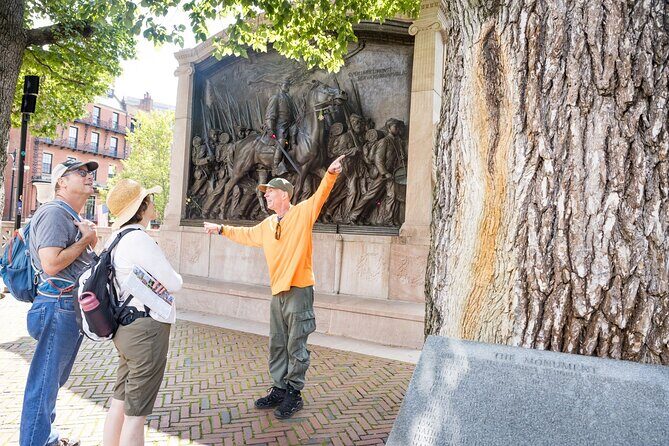
- Small group (max 15), so questions don’t get lost in the crowd
- Brian’s local, historian-style commentary that ties buildings to what really happened
- A walking format that keeps you looking at the right stuff, not just passing it
- Eight+ Freedom Trail stops that cover both Revolution-era government and church life
- Granary Burying Ground admission included, while other stops are free to enter
- Mobile ticket for an easier start at the meeting point
Finding Your Place on the Freedom Trail (and not getting lost)
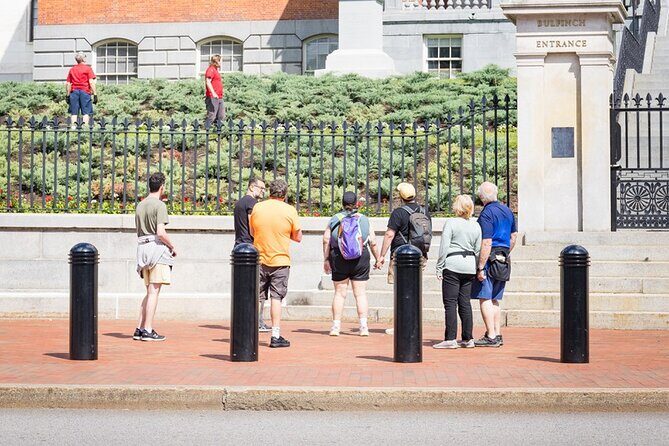
This tour is built for one simple goal: getting your bearings fast. The Freedom Trail can feel like a lot of separate landmarks, especially if you try to do it on your own. Here, you get a guided path that helps you see cause and effect, not just dates.
You start at Tremont St & Park Street & Winter St. It’s an easy area to reach using public transport, and it sets you up for the first stop, Boston Common. From there, the walk keeps nudging you forward with context, so each corner feels connected to the next one.
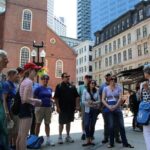
It runs about 2 hours and is offered in English, with a maximum of 15 travelers. That smaller size matters. You’re not stuck waiting for a chance to ask what something means, or where it fits in the broader story.
You can also read our reviews of more tours and experiences in Boston.


Boston Common: America’s oldest public park as your warm-up
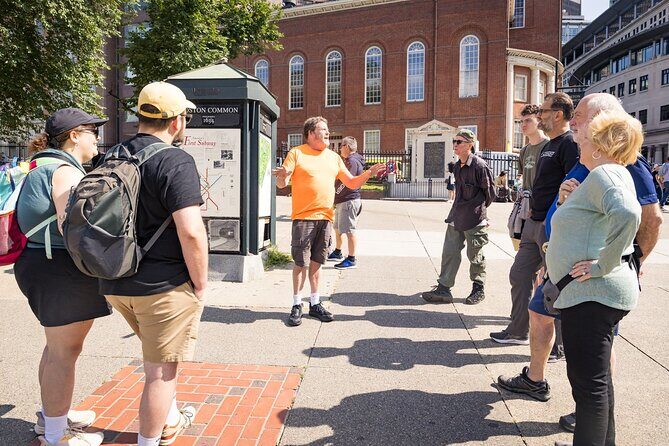
Boston Common (founded in 1634) is not just a pretty starting point. It’s the kind of place where the timeline sticks to your mind because you can stand still and look around while ideas settle in.
You’ll hear how the park played roles over multiple eras, including British troop encampments during the Revolutionary War and later civil rights rallies. That mix is useful because it prevents the trail from turning into a museum-only experience. Boston’s history didn’t stop in 1776.
Practical note: this is the part of the day where you can benefit from listening closely. Once you’ve got the park’s background, the rest of the walk stops feeling random. Admission here is free.
Massachusetts State House and Park Street Church: where values show up in stone
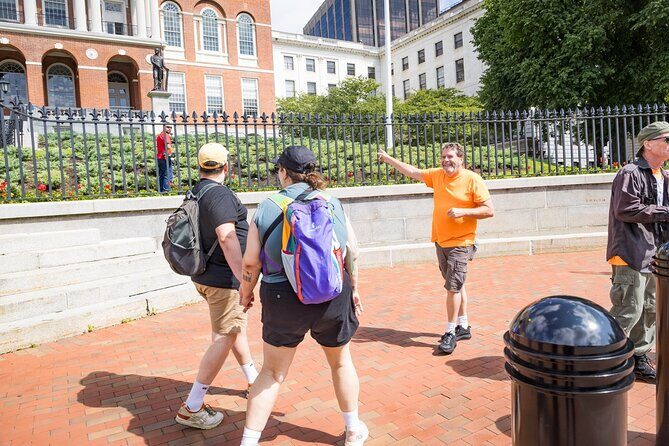
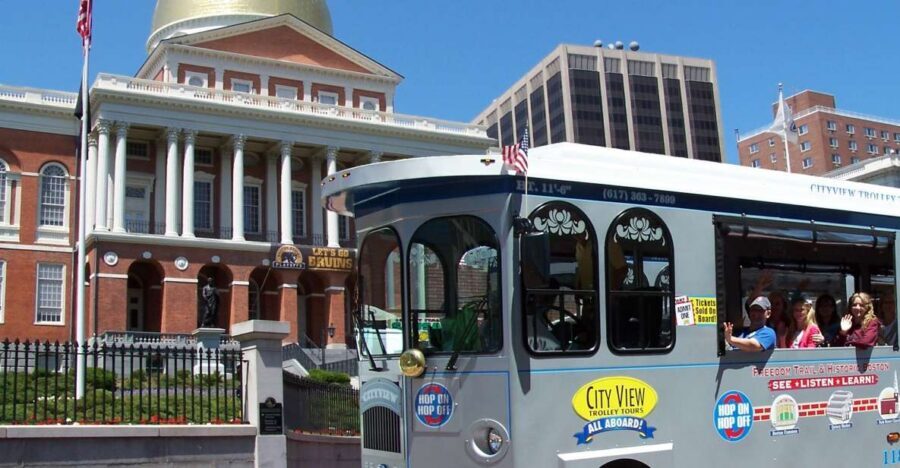
Next comes the Massachusetts State House. Completed in 1798, it’s known for its golden dome, and the tour’s angle is about why it’s more than an architectural photo stop. You’ll get the sense of how government works in real life: legislation happens in people-shaped spaces, not just on paper.
From there, you’ll walk to Park Street Church (erected in 1809). This stop is a good reminder that the Freedom Trail is not only about fighting with weapons. It’s also about using words. Park Street Church is tied to the first public anti-slavery address in the U.S., and you’ll see how the steeple isn’t only a skyline landmark. It’s also a signal that public moral arguments have long had a physical home in Boston.
Both of these stops are free to enter, and the short time at each one is intentional. You’re not trying to tour every interior room. You’re learning what to notice on the outside and what questions to carry with you.
Granary Burying Ground: the Revolution shows up in names
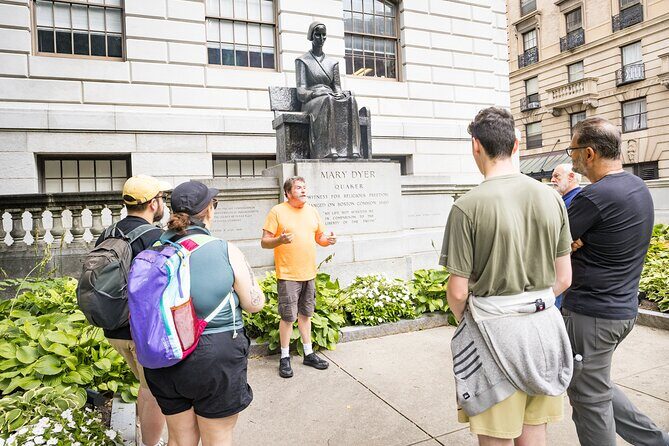
If you want the strongest emotional anchor on the route, it’s usually Granary Burying Ground. This is one of Boston’s oldest historic cemeteries, and the tour treats it like more than a background stop.
You’ll learn about notable Revolutionary-era figures buried here, including Paul Revere, Samuel Adams, and John Hancock. And this is also where Crispus Attucks comes in. He’s remembered as the first casualty of the Boston Massacre and a symbol of the fight for freedom. That connection turns a cemetery into a lesson about who gets remembered—and why.
This stop includes admission (included), which is a nice value touch. If you’re doing the Freedom Trail as a DIY walk, cemetery time can be awkward without knowing what to look for. With a guide, you know the names and can connect them to larger events.
One word of caution: this is a somber place. The best way to enjoy it is to slow your own pace for a few minutes, even if the overall tour is moving quickly.
King’s Chapel: Georgian architecture with Revolution-era tension
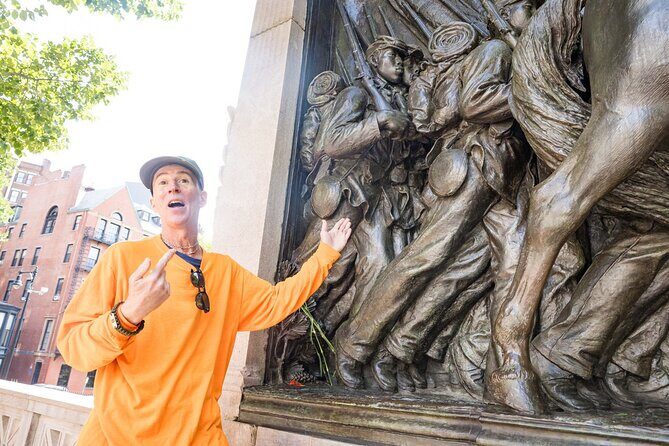
King’s Chapel (built in 1754) is a striking example of Georgian architecture, and it comes with a story that adds nuance. You’ll hear about its ties to loyalist congregants during the Revolution, plus its continued role in Boston’s spiritual community.
That loyalist connection is useful because it stops the narrative from becoming one-note. The Revolution story wasn’t only one side versus another. People had complicated loyalties, and institutions did too. Standing at a church helps you see how community life could differ from political messaging happening elsewhere.
Admission here is free. The time is short, so focus on the big shapes and details the guide points out rather than trying to read everything yourself.




Old South Meeting House: where talk became action
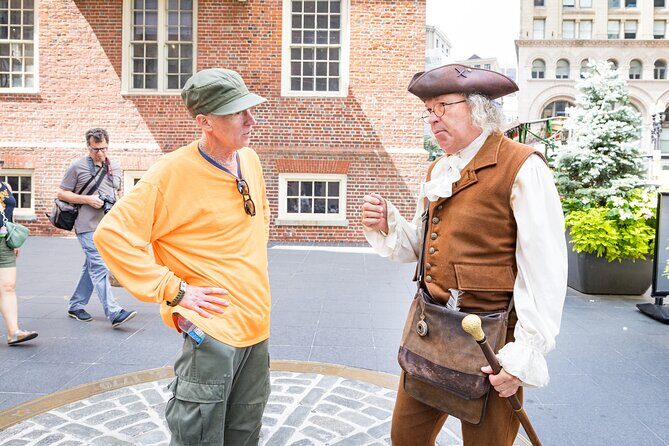
Old South Meeting House (built in 1729) is one of the most “oh, right” stops on the Freedom Trail. The tour connects it directly to the Boston Tea Party, including how plans were set into motion there.
This stop is valuable because it reframes the Revolution as something organized and loud long before any fireworks. A meeting house is exactly the kind of setting where debate, persuasion, and group momentum turn into real-world action.
Admission here is free. In the short time you’re there, it helps to listen for how speech and organizing worked back then. You’ll get a clearer sense of why Faneuil Hall later earned the nickname Cradle of Liberty.
Old State House: the balcony moment and why people gathered
Then you get to the Old State House (dating to 1713), which was the seat of colonial government. This stop is all about seeing how authority looked and how events escalated within view of the public.
The tour highlights the building’s role in key revolutionary moments, including the fact that the Declaration of Independence was read from the balcony. That detail is the kind of thing that makes you understand why crowds mattered. The message wasn’t just written. It was delivered where people could react.
Admission here is free. Since you only get about 15 minutes at each stop, you’ll want to come in ready to process. If you tend to move fast through photos, try switching your mental mode: watch for how the guide ties each building to the next step in the story.
Faneuil Hall: the debates that earned Cradle of Liberty
The walk finishes at Faneuil Hall, often described as the Cradle of Liberty. It’s been a marketplace and meeting hall since 1742, and it’s remembered for fiery debates and speeches pushing toward independence.
This final stop works especially well because you’ve already built context along the way. When you reach Faneuil Hall, it stops being a single landmark and starts acting like the loud conclusion to the earlier discussion-based stops.
This is also a practical win: the tour ends at Faneuil Hall Marketplace, a convenient place to keep exploring with food and other sights nearby.
Admission is free. The best approach here is to listen for what changed over time: from organizing and arguing, to the point where independence rhetoric turned into a bigger public movement.
The guide matters: Brian’s local historian style and high-energy delivery
A lot of walking tours succeed or fail on the guide, and this one leans hard into the guide experience. The name that comes up often is Brian. He’s described as having remarkable local expertise, with a historian’s instinct for accuracy and detail.
The part I like for you: you’re not just hearing dates. Brian connects the landmarks to what was happening socially and politically around them. That’s also why the tour can feel like more than a straight line of stops. You may hear extra historical nuggets tied to what’s right in front of you.
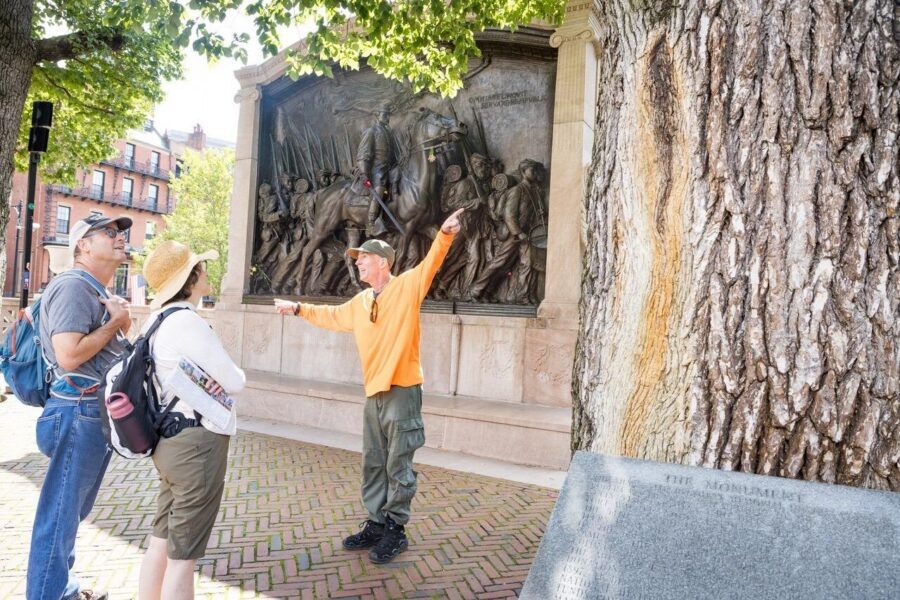
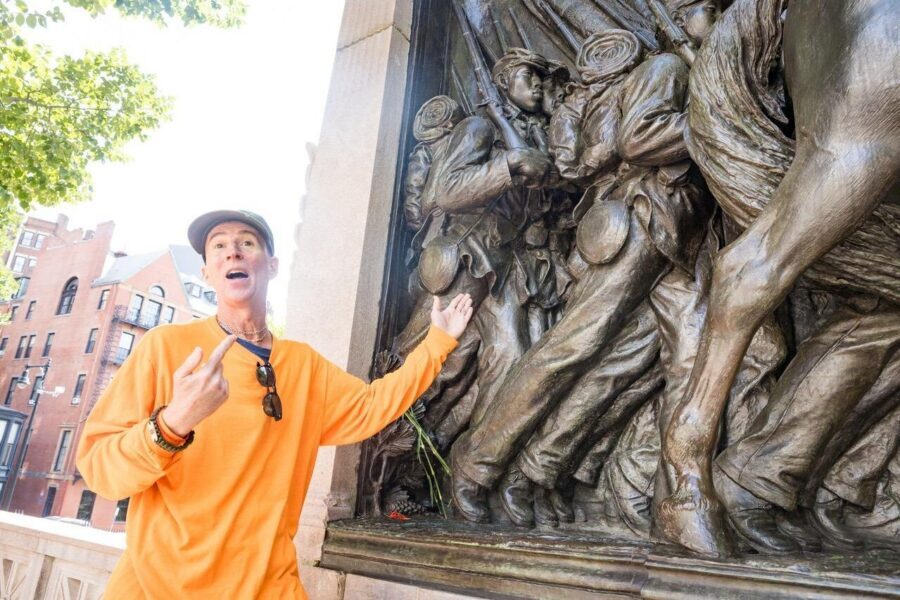
For example, one frequently mentioned detail is the 54th Regiment Memorial on Boston Common, including a playful note about the sword being rubber. It sounds small, but it tells you something important: the guide uses human-scale details to make the past feel real. You might also hear about the Granary’s Franklin Memorial in a way that helps you remember the site beyond the main names.
That said, the same high energy that makes the tour fun can be a drawback. One caution I’d give: if you dislike rapid-fire commentary or you want extra quiet time, the tour may feel like it’s moving too fast for your brain to keep up. If that’s you, focus on key questions to ask early, while you’re still fresh.
Timing, walking pace, and the 15-minute stop rhythm
Each stop is roughly 15 minutes. That structure is part of the value. You get enough time to understand why a place matters, but not so long that you’re stuck waiting for the group.
The tradeoff is that the information can stack up quickly. If you’re the type who likes to read plaques for a long time, you may feel slightly rushed. The good news: a guide can explain what you’d otherwise skim, which helps you retain the core story.
Since the whole thing is about 2 hours, wear comfortable walking shoes. You’re doing a lot of streets and sidewalks, and you’ll want your legs to feel good enough to keep paying attention after the first couple stops.
Price and value: is $39 a smart use of time?
At $39 per person for about 2 hours, this is positioned as an efficient way to learn the Freedom Trail without grinding through it alone.
Here’s why I think it’s good value if your goal is context:
- You’re getting a live local historian guide, not just a generic script.
- You get multiple major Freedom Trail landmarks plus extra interpretive links that help the story make sense.
- Granary Burying Ground admission is included, which is a small but real cost-off-set.
- It’s a small-group tour, so it’s not a cattle-car approach.
Compare that to DIY. If you walk the trail by yourself, you can absolutely do it. But you’ll spend time figuring out what matters and you’ll likely miss the deeper connections that make the trail memorable. Paying for the guided format is basically buying back your attention.
So the “value question” really comes down to you: if you want facts with a clear through-line and you’re short on time, this rate is reasonable. If you prefer slow independent exploring and you’re great at self-guided research, you might feel like you could do it cheaper. But you’ll trade away the story-telling and Q&A.
Who should book this Freedom Trail walking tour?
This is a great fit if:
- You want the Freedom Trail in a tight, organized timeline
- You like asking questions and hearing direct answers
- You enjoy historical storytelling that connects buildings to events
It may be less ideal if:
- You’re traveling with very young kids who need more stop-and-go flexibility
- You prefer quiet tours with minimal commentary
- You want lots of time for reading and lingering
If you’re somewhere in the middle, I’d still say it can work well. Just set expectations: this is a guided walk, not a self-paced museum.
Should you book Freedom Trail: Boston Common, Old State House, Faneuil Hall?
I’d book it if you want a clear Freedom Trail experience with a guide who tells the story in a way that clicks. For $39, you get a small-group format, a strong mix of government, church, and public meeting places, and a finish at Faneuil Hall that leaves you ready to keep exploring.
Skip it if you hate information density or you know you need a slower pace with lots of independent wandering. In that case, you’d probably enjoy doing the Freedom Trail at your own tempo instead.
FAQ
How long is the Freedom Trail walking tour?
The tour lasts about 2 hours.
What does the tour cost?
It costs $39.00 per person.
Where does the tour start and end?
It starts at Tremont St & Park Street & Winter St, Boston, MA 02108 and ends at Faneuil Hall Marketplace, Boston, MA 02109.
What time does the tour begin?
The start time listed is 10:30 am.
Is admission included at the stops?
Boston Common, Massachusetts State House, Park Street Church, King’s Chapel, Old South Meeting House, Old State House, and Faneuil Hall are listed as free. Granary Burying Ground has admission included.
Are tickets mobile?
Yes. The tour includes a mobile ticket.
What’s the group size limit?
The tour has a maximum of 15 travelers.